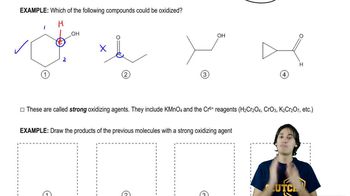
Give the structure of the principal product(s) when each of the following alcohols reacts with (1) Na2Cr2O7/H2SO4, (2) PCC d. 1-methylcyclohexan-1,4-diol
Verified step by step guidance
1
Step 1: Understand the reagents involved in the reaction. Sodium dichromate (Na₂Cr₂O₇) in the presence of sulfuric acid (H₂SO₄) is a strong oxidizing agent that can oxidize primary alcohols to carboxylic acids and secondary alcohols to ketones. Pyridinium chlorochromate (PCC) is a milder oxidizing agent that oxidizes primary alcohols to aldehydes and secondary alcohols to ketones without further oxidation.
Step 2: Analyze the structure of the given compound, 1-methylcyclohexan-1,4-diol. This molecule contains two hydroxyl (-OH) groups: one at the 1-position (attached to a tertiary carbon) and one at the 4-position (attached to a secondary carbon). The oxidation behavior of these groups will depend on the type of carbon they are attached to.
Step 3: Predict the reaction with Na₂Cr₂O₇/H₂SO₄. The tertiary alcohol at the 1-position will not undergo oxidation because tertiary alcohols are resistant to oxidation under these conditions. The secondary alcohol at the 4-position will be oxidized to a ketone, resulting in the formation of 1-methylcyclohexan-4-one.
Step 4: Predict the reaction with PCC. Similar to the strong oxidizing agent, PCC will not oxidize the tertiary alcohol at the 1-position. The secondary alcohol at the 4-position will be oxidized to a ketone, resulting in the same product, 1-methylcyclohexan-4-one.
Step 5: Summarize the principal product(s). In both cases (Na₂Cr₂O₇/H₂SO₄ and PCC), the principal product is 1-methylcyclohexan-4-one, as only the secondary alcohol at the 4-position undergoes oxidation to a ketone.
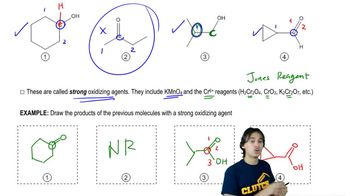
Verified video answer for a similar problem:
This video solution was recommended by our tutors as helpful for the problem above
Video duration:
4m
Play a video:
0 Comments
Key Concepts
Here are the essential concepts you must grasp in order to answer the question correctly.
Oxidation of Alcohols
Alcohols can undergo oxidation to form carbonyl compounds, such as aldehydes or ketones, depending on the structure of the alcohol and the oxidizing agent used. Primary alcohols typically oxidize to aldehydes, while secondary alcohols convert to ketones. Tertiary alcohols do not oxidize easily due to the lack of a hydrogen atom on the carbon bearing the hydroxyl group.
Different oxidizing agents can yield different products from alcohols. Sodium dichromate (Na2Cr2O7) in acidic conditions is a strong oxidizer that can fully oxidize primary alcohols to carboxylic acids and secondary alcohols to ketones. In contrast, pyridinium chlorochromate (PCC) is a milder oxidizing agent that selectively oxidizes primary alcohols to aldehydes and secondary alcohols to ketones without further oxidation.
Diols, or glycols, contain two hydroxyl (-OH) groups. The position and substitution of these groups significantly influence their reactivity during oxidation. In the case of 1-methylcyclohexan-1,4-diol, the presence of hydroxyl groups at the 1 and 4 positions allows for potential oxidation at both sites, leading to different products depending on the oxidizing agent used.


 4:04 minutes
 Verified step by step guidance
 05:53
05:53