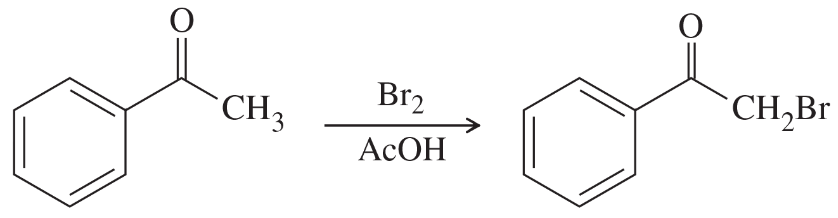
Propose mechanisms for the following reactions. (e)
Verified step by step guidance
1
Step 1: Recognize the reaction type. This is an alpha-halogenation reaction of a ketone. The methyl group adjacent to the carbonyl group is the alpha position, which is susceptible to halogenation in the presence of bromine (Br₂) and acetic acid (AcOH).
Step 2: Protonation of the carbonyl oxygen. Acetic acid acts as a catalyst and protonates the oxygen atom of the carbonyl group, increasing the electrophilicity of the carbonyl carbon and making the alpha-hydrogens more acidic.
Step 3: Formation of the enol intermediate. The acidic environment facilitates the removal of an alpha-hydrogen by acetic acid, leading to the formation of the enol tautomer. The enol has a double bond between the alpha-carbon and the carbonyl carbon, and the hydroxyl group is attached to the carbonyl carbon.
Step 4: Electrophilic attack by bromine. The enol intermediate reacts with bromine (Br₂), where the double bond of the enol attacks a bromine molecule, leading to the formation of a bromonium ion. This results in the substitution of a bromine atom at the alpha-carbon.
Step 5: Regeneration of the ketone. The brominated enol tautomer undergoes tautomerization back to the ketone form, resulting in the final product, where the alpha-carbon is substituted with a bromine atom.
Verified video answer for a similar problem:
This video solution was recommended by our tutors as helpful for the problem above
Video duration:
7m
Play a video:
Was this helpful?
Key Concepts
Here are the essential concepts you must grasp in order to answer the question correctly.
Reaction Mechanisms
A reaction mechanism is a step-by-step description of how a chemical reaction occurs at the molecular level. It outlines the sequence of elementary steps, including bond breaking and formation, and the intermediates formed during the reaction. Understanding mechanisms is crucial for predicting the products and understanding the kinetics and thermodynamics of the reaction.
Organic reactions can be classified into several types, including substitution, addition, elimination, and rearrangement reactions. Each type has distinct characteristics and mechanisms. Recognizing the type of reaction helps in predicting the behavior of reactants and the nature of the products formed, which is essential for proposing accurate mechanisms.
Curved arrow notation is a visual representation used in organic chemistry to illustrate the movement of electrons during a reaction. Arrows indicate the direction of electron flow, showing how bonds are broken and formed. Mastery of this notation is vital for accurately depicting reaction mechanisms and understanding the underlying processes in organic reactions.