A ketone undergoes acid-catalyzed bromination, acid-catalyzed chlorination, racemization, and acid-catalyzed deuterium exchange at the ⍺-carbon. All of these reactions have similar rate constants.What does this tell you about the mechanisms of these reactions?
Verified step by step guidance
1
The first step is to recognize that all the reactions mentioned (acid-catalyzed bromination, chlorination, racemization, and deuterium exchange) occur at the α-carbon of the ketone. This suggests that the α-carbon is the reactive site in all these processes.
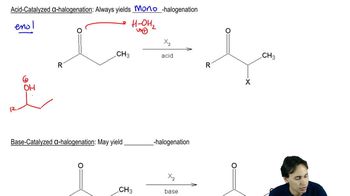
Next, consider the role of the acid catalyst. The acid protonates the carbonyl oxygen of the ketone, increasing the electrophilicity of the carbonyl carbon and making the α-hydrogen more acidic. This facilitates the formation of an enol intermediate or an enolate ion under acidic conditions.
Understand that the enol (or enolate) intermediate is common to all these reactions. The similar rate constants for all the reactions indicate that the rate-determining step is the same for each reaction, which is the formation of the enol intermediate from the ketone.
For bromination and chlorination, the enol reacts with the halogen (Br₂ or Cl₂) to form the halogenated product. For racemization, the enol tautomerizes back to the ketone, potentially leading to a loss of stereochemical integrity. For deuterium exchange, the enol reacts with D₂O, replacing the α-hydrogen with deuterium.
Finally, conclude that the similar rate constants for all these reactions strongly suggest that the formation of the enol intermediate is the rate-determining step, and the subsequent steps (halogenation, tautomerization, or exchange) are faster and do not significantly affect the overall reaction rate.
Verified video answer for a similar problem:
This video solution was recommended by our tutors as helpful for the problem above
Video duration:
5m
Play a video:
Was this helpful?
Key Concepts
Here are the essential concepts you must grasp in order to answer the question correctly.
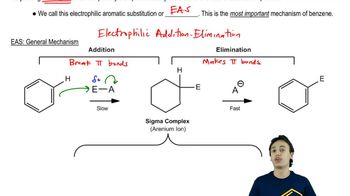
Mechanism of Electrophilic Aromatic Substitution
In electrophilic aromatic substitution reactions, an electrophile replaces a hydrogen atom on an aromatic ring. The rate of these reactions is influenced by the stability of the carbocation intermediate formed during the process. Understanding this mechanism is crucial for analyzing how ketones react under acidic conditions, as the presence of electron-withdrawing groups can affect the reactivity and orientation of the electrophile.
Acid-catalyzed reactions involve the use of an acid to increase the rate of a chemical reaction. In the context of ketones, the acid can protonate the carbonyl oxygen, enhancing the electrophilicity of the carbonyl carbon. This makes the carbon more susceptible to nucleophilic attack, which is essential for understanding the bromination and chlorination processes mentioned in the question.
Racemization refers to the process where a chiral molecule converts into a mixture of its enantiomers, resulting in a loss of optical activity. In the context of the reactions described, the similar rate constants suggest that the mechanisms leading to racemization and deuterium exchange involve similar transition states or intermediates. This indicates that the stereochemical outcomes of these reactions are closely related, providing insight into the underlying reaction pathways.