Predict the products of the following reactions. (a) cyclopentanone + Br2 in acetic acid
Verified step by step guidance
1
Identify the type of reaction: The reaction involves cyclopentanone and bromine (Br₂) in acetic acid. This is a halogenation reaction under acidic conditions, specifically an alpha-halogenation of a ketone.
Determine the reactive site: In acidic conditions, the alpha-hydrogens (hydrogens attached to the carbon adjacent to the carbonyl group) of cyclopentanone are acidic and can be removed to form an enol intermediate.
Form the enol intermediate: The carbonyl oxygen of cyclopentanone is protonated by the acidic medium, increasing the electrophilicity of the carbonyl carbon. This facilitates the formation of the enol tautomer by deprotonation of an alpha-hydrogen.
React the enol with bromine: The enol intermediate reacts with Br₂, where the double bond of the enol attacks the bromine molecule. This results in the substitution of one alpha-hydrogen with a bromine atom, forming an alpha-bromoketone.
Conclude the product: The final product is an alpha-brominated cyclopentanone, where one of the alpha-hydrogens has been replaced by a bromine atom. Ensure to consider regioselectivity if there are multiple alpha-hydrogens.
Verified video answer for a similar problem:
This video solution was recommended by our tutors as helpful for the problem above
Video duration:
6m
Play a video:
Was this helpful?
Key Concepts
Here are the essential concepts you must grasp in order to answer the question correctly.
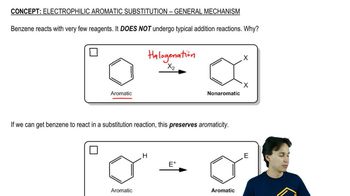
Electrophilic Aromatic Substitution
Electrophilic aromatic substitution is a fundamental reaction mechanism in organic chemistry where an electrophile replaces a hydrogen atom on an aromatic ring. In the case of cyclopentanone, while it is not an aromatic compound, understanding this mechanism is crucial for predicting how electrophiles like Br2 interact with carbonyl compounds. The presence of acetic acid as a solvent can also influence the reaction pathway and product formation.
Halogenation of ketones involves the substitution of a hydrogen atom in the ketone structure with a halogen atom, such as bromine. This reaction typically occurs at the alpha position relative to the carbonyl group, leading to the formation of alpha-halo ketones. The reaction conditions, including the solvent and temperature, can significantly affect the regioselectivity and yield of the halogenated product.
Carbonyl compounds, such as ketones and aldehydes, exhibit unique reactivity due to the polarized carbon-oxygen double bond. This polarization makes the carbon atom electrophilic, allowing it to react with nucleophiles and electrophiles. Understanding the reactivity of carbonyl compounds is essential for predicting the outcomes of reactions involving cyclopentanone and Br2, as it determines how the carbonyl will interact with the halogen.