Acid-catalyzed halogenation is synthetically useful for converting ketones to α,β-unsaturated ketones, which are useful in Michael reactions (Section 22-18). Propose a method for converting cyclohexanone to cyclohex-2-en-1-one, an important synthetic starting material.
Verified step by step guidance
1
Step 1: Recognize that the transformation involves converting a ketone (cyclohexanone) into an α,β-unsaturated ketone (cyclohex-2-en-1-one). This is typically achieved through an enolate intermediate followed by elimination.
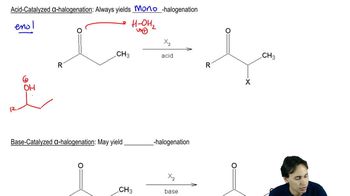
Step 2: Begin by treating cyclohexanone with a catalytic amount of acid (e.g., HCl or H2SO4) to facilitate the formation of the enol tautomer. The enol tautomer is in equilibrium with the ketone form.
Step 3: Introduce a halogen source, such as Br2 or Cl2, in the presence of the acid catalyst. The enol form of cyclohexanone reacts with the halogen to form an α-halo ketone. This step is known as α-halogenation.
Step 4: Subject the α-halo ketone to a base (e.g., NaOH or KOH). The base abstracts a proton from the β-carbon, leading to the formation of a double bond between the α and β carbons. This elimination step produces the desired α,β-unsaturated ketone.
Step 5: Purify the product (cyclohex-2-en-1-one) using standard organic chemistry techniques such as distillation or recrystallization, depending on the reaction conditions and product properties.
Verified video answer for a similar problem:
This video solution was recommended by our tutors as helpful for the problem above
Video duration:
10m
Play a video:
Was this helpful?
Key Concepts
Here are the essential concepts you must grasp in order to answer the question correctly.
Acid-Catalyzed Halogenation
Acid-catalyzed halogenation involves the addition of halogens to carbonyl compounds in the presence of an acid catalyst. This reaction typically leads to the formation of α-halo ketones, which can undergo further transformations. The acid activates the carbonyl, making it more electrophilic and susceptible to nucleophilic attack by halide ions.
α,β-Unsaturated ketones are compounds that contain a carbon-carbon double bond adjacent to a carbonyl group. These structures are important in organic synthesis as they can participate in various reactions, such as Michael additions, where nucleophiles add to the β-position. Their reactivity is influenced by the conjugation between the double bond and the carbonyl, enhancing electrophilicity.
The difference between saturated and unsaturated molecules.
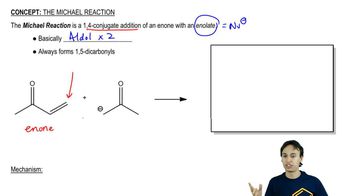
Michael Reaction
The Michael reaction is a nucleophilic addition reaction where a nucleophile adds to an α,β-unsaturated carbonyl compound. This reaction is significant in forming carbon-carbon bonds and is widely used in synthetic organic chemistry. The nucleophile typically attacks the β-carbon, leading to the formation of a new carbon-carbon bond and resulting in a more complex molecule.