The Gabriel synthesis is most frequently done with 1° alkyl halides. Why is it less successful with more substituted halides?
Verified step by step guidance
1
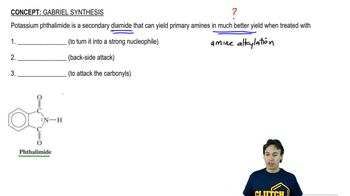
Understand the Gabriel synthesis: It is a method used to synthesize primary amines from primary alkyl halides using phthalimide as a nitrogen source.
Recognize the mechanism: The synthesis involves the nucleophilic substitution of the alkyl halide by the phthalimide anion, forming an N-alkylphthalimide intermediate.
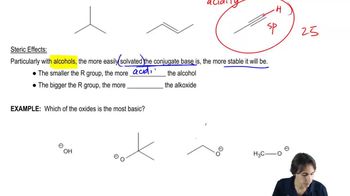
Consider steric hindrance: More substituted alkyl halides, such as secondary or tertiary halides, have increased steric hindrance, which can impede the nucleophilic attack by the phthalimide anion.
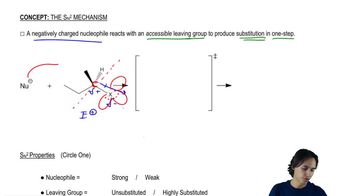
Evaluate the reaction type: The Gabriel synthesis typically involves an SN2 reaction mechanism, which is less favorable with sterically hindered substrates due to the backside attack requirement.
Conclude the effect of substitution: As the degree of substitution on the alkyl halide increases, the efficiency of the Gabriel synthesis decreases due to steric hindrance and the reduced likelihood of successful SN2 reactions.
Verified video answer for a similar problem:
This video solution was recommended by our tutors as helpful for the problem above
Video duration:
2m
Play a video:
Was this helpful?
Key Concepts
Here are the essential concepts you must grasp in order to answer the question correctly.
Gabriel Synthesis
The Gabriel synthesis is a method used to synthesize primary amines from primary alkyl halides. It involves the use of phthalimide as a nitrogen source, which reacts with the alkyl halide to form an N-alkylphthalimide intermediate. This intermediate is then hydrolyzed to yield the primary amine. The reaction is particularly suited for primary alkyl halides due to their reactivity and lack of steric hindrance.
Steric hindrance refers to the prevention of chemical reactions due to the size of groups within a molecule. In the context of the Gabriel synthesis, more substituted alkyl halides, such as secondary or tertiary halides, have larger groups attached to the carbon bearing the halide. This bulkiness can impede the nucleophilic attack by the phthalimide ion, making the reaction less successful compared to primary alkyl halides.
The SN2 mechanism is a bimolecular nucleophilic substitution reaction where the nucleophile attacks the electrophilic carbon from the opposite side of the leaving group, resulting in an inversion of configuration. This mechanism is favored by primary alkyl halides due to minimal steric hindrance. In the Gabriel synthesis, the phthalimide ion acts as the nucleophile, and the reaction is less effective with more substituted halides because steric hindrance hinders the backside attack required for SN2 reactions.