Predict the product(s) of the reactions shown. (i)
Verified step by step guidance
1
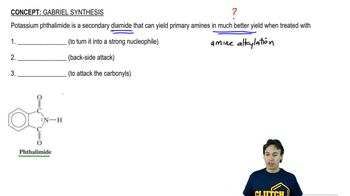
Step 1: Identify the starting material as phthalimide, which is a cyclic imide derived from phthalic acid.
Step 2: Recognize the first reagent, nBuBr (n-butyl bromide), which is an alkyl halide. This suggests an alkylation reaction where the nitrogen atom of the phthalimide will act as a nucleophile.
Step 3: Understand that the phthalimide nitrogen will attack the n-butyl bromide, displacing the bromide ion and forming N-butylphthalimide.
Step 4: Note the second step involves KOH and hydrazine (H2NNH2) under heat (Δ). This indicates a Gabriel synthesis, where the phthalimide is converted to a primary amine.
Step 5: In the Gabriel synthesis, hydrazine reacts with N-butylphthalimide to release the primary amine, n-butylamine, and form phthalhydrazide as a byproduct.
Verified video answer for a similar problem:
This video solution was recommended by our tutors as helpful for the problem above
Video duration:
2m
Play a video:
Was this helpful?
Key Concepts
Here are the essential concepts you must grasp in order to answer the question correctly.
Nucleophilic Substitution Reaction
Nucleophilic substitution is a fundamental class of reactions in organic chemistry where a nucleophile selectively bonds with or attacks the positive or partially positive charge of an atom or a group of atoms to replace a leaving group. In the given reaction, nBuBr (n-butyl bromide) acts as the alkylating agent, where the bromide ion is the leaving group, and the nitrogen atom in the imide acts as the nucleophile.
Nucleophiles and Electrophiles can react in Substitution Reactions.
Gabriel Synthesis
Gabriel synthesis is a method used to synthesize primary amines from primary alkyl halides. The reaction involves the use of phthalimide, which is deprotonated to form a nucleophilic phthalimide anion that reacts with an alkyl halide. In this reaction, the phthalimide is alkylated by nBuBr, and subsequent hydrazinolysis releases the primary amine, n-butylamine.
Hydrazinolysis is a chemical reaction where hydrazine is used to cleave a bond, often in the context of removing protecting groups. In the Gabriel synthesis, hydrazinolysis is used to convert the N-alkylphthalimide intermediate into the corresponding primary amine. Here, hydrazine reacts with the alkylated phthalimide to release n-butylamine and phthalhydrazide as a byproduct.