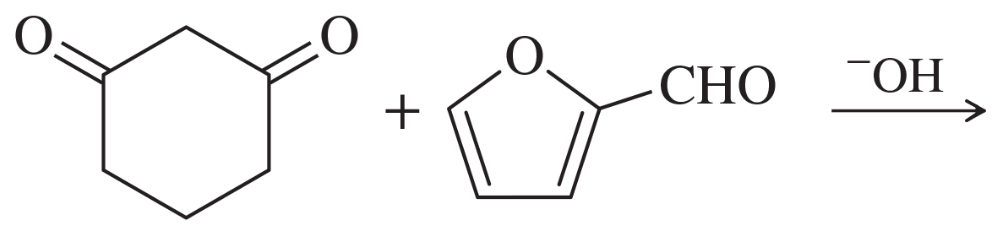
Predict the products of the following aldol condensations. Show the products both before and after dehydration. (e)
Verified step by step guidance
1
Step 1: Identify the reactants involved in the aldol condensation. The first reactant is cyclohexane-1,3-dione, which has two alpha hydrogens available for enolate formation. The second reactant is furfural, an aldehyde with an aromatic furan ring.
Step 2: Determine the enolate formation. Under basic conditions (-OH), cyclohexane-1,3-dione will form an enolate ion at one of its alpha positions. This enolate will act as a nucleophile.
Step 3: Perform the nucleophilic attack. The enolate ion from cyclohexane-1,3-dione will attack the carbonyl carbon of furfural, forming a β-hydroxy ketone intermediate. This is the product before dehydration.
Step 4: Dehydration step. Under the reaction conditions, the β-hydroxy ketone intermediate will undergo dehydration (loss of water) to form an α,β-unsaturated ketone. This involves the elimination of a hydroxyl group and a hydrogen atom, creating a double bond between the alpha and beta carbons.
Step 5: Draw the final product. The final product after dehydration will be a conjugated system with a double bond between the alpha and beta carbons of the cyclohexane ring, and the furfural group attached to the beta carbon.
Verified video answer for a similar problem:
This video solution was recommended by our tutors as helpful for the problem above
Video duration:
5m
Play a video:
Was this helpful?
Key Concepts
Here are the essential concepts you must grasp in order to answer the question correctly.
Aldol Condensation
Aldol condensation is a reaction between aldehydes or ketones that contain alpha-hydrogens, leading to the formation of β-hydroxy aldehydes or ketones (aldols). This reaction involves the nucleophilic addition of an enolate ion to a carbonyl compound, followed by dehydration to yield an α,β-unsaturated carbonyl compound. Understanding this process is crucial for predicting the products of the reaction.
Dehydration in aldol reactions refers to the elimination of a water molecule from the β-hydroxy carbonyl compound formed during the aldol condensation. This step is essential as it converts the aldol into a more stable α,β-unsaturated carbonyl compound, which is often the final product of the reaction. Recognizing the conditions that favor dehydration helps in predicting the final products.
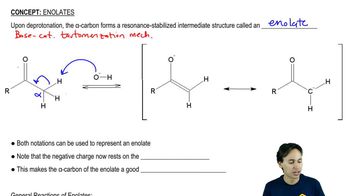
Enolate ions are key intermediates in aldol reactions, formed by the deprotonation of the alpha-hydrogen of a carbonyl compound. This ion acts as a nucleophile, attacking another carbonyl carbon to initiate the aldol condensation. Understanding how enolate ions are generated and their reactivity is vital for predicting the outcome of the aldol condensation process.