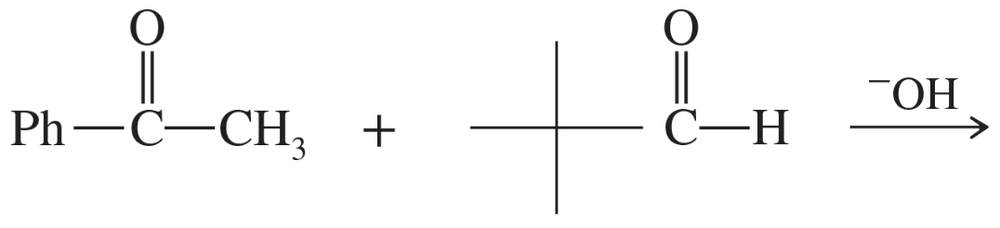
Predict the products of the following aldol condensations. Show the products both before and after dehydration. (d)
Verified step by step guidance
1
Step 1: Identify the reactants involved in the aldol condensation. The first reactant is acetophenone (Ph-C(O)-CH3), and the second reactant is formaldehyde (H-C(O)-H). The reaction occurs under basic conditions (-OH).
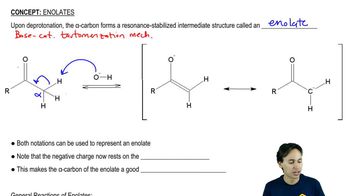
Step 2: Determine the enolate formation. Under basic conditions, the alpha-hydrogen of acetophenone is abstracted by the hydroxide ion, forming an enolate ion. The enolate ion is nucleophilic at the alpha-carbon.
Step 3: Perform the nucleophilic attack. The enolate ion attacks the carbonyl carbon of formaldehyde, forming a beta-hydroxy ketone intermediate. This intermediate is the product before dehydration.
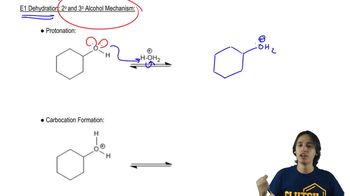
Step 4: Analyze the dehydration step. Under the reaction conditions, the beta-hydroxy ketone undergoes dehydration (loss of water) to form an α,β-unsaturated ketone. This occurs via an E1cB mechanism, where the hydroxide ion abstracts a proton from the alpha-carbon, and the hydroxyl group is eliminated.
Step 5: Write the final products. The product before dehydration is the beta-hydroxy ketone, and the product after dehydration is the α,β-unsaturated ketone. The α,β-unsaturated ketone has a conjugated double bond system, enhancing its stability.
Verified video answer for a similar problem:
This video solution was recommended by our tutors as helpful for the problem above
Video duration:
4m
Play a video:
Was this helpful?
Key Concepts
Here are the essential concepts you must grasp in order to answer the question correctly.
Aldol Condensation
Aldol condensation is a reaction between aldehydes or ketones that contain alpha-hydrogens, leading to the formation of β-hydroxy aldehydes or ketones (aldols). This reaction involves the nucleophilic addition of an enolate ion to a carbonyl compound, followed by dehydration to yield α,β-unsaturated carbonyl compounds. Understanding this process is crucial for predicting the products of the reaction shown.
Enolate ions are formed when a base abstracts an alpha-hydrogen from a carbonyl compound, resulting in a resonance-stabilized anion. This ion acts as a nucleophile in aldol reactions, attacking the carbonyl carbon of another aldehyde or ketone. Recognizing how enolate ions are generated and their role in the reaction mechanism is essential for predicting the products of aldol condensations.
The dehydration step in aldol condensation involves the elimination of a water molecule from the β-hydroxy carbonyl compound, resulting in the formation of an α,β-unsaturated carbonyl compound. This step is driven by the stability of the resulting double bond and is crucial for completing the reaction. Understanding this transformation is key to predicting the final products of the aldol condensation process.