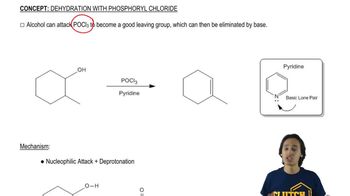
Predict the products of the following aldol condensations. Show the products both before and after dehydration. (c)
Verified step by step guidance
1
Step 1: Identify the reactants and the type of reaction. The reactants are benzaldehyde (PhCHO) and acetone (CH3COCH3), and the reaction is an aldol condensation under basic conditions (-OH). Aldol condensation involves the formation of a β-hydroxy ketone or aldehyde followed by dehydration to form an α,β-unsaturated carbonyl compound.
Step 2: Determine the enolate formation. Under basic conditions, acetone will form an enolate ion by deprotonation of one of its α-hydrogens. The enolate ion is nucleophilic and will attack the electrophilic carbonyl carbon of benzaldehyde.
Step 3: Perform the nucleophilic addition. The enolate ion from acetone attacks the carbonyl carbon of benzaldehyde, forming a β-hydroxy ketone intermediate. This intermediate contains both a hydroxyl group (-OH) and a ketone group (-C=O) on adjacent carbons.
Step 4: Dehydration of the β-hydroxy ketone. Under the reaction conditions, the β-hydroxy ketone undergoes elimination of water (dehydration) to form an α,β-unsaturated ketone. This step involves the formation of a double bond between the α and β carbons.
Step 5: Predict the final product. After dehydration, the product will be an α,β-unsaturated ketone where the benzaldehyde-derived phenyl group (Ph) is attached to the β-carbon of the unsaturated ketone. The structure of the product can be represented as Ph-CH=CH-COCH3.
Verified video answer for a similar problem:
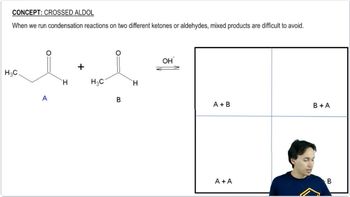
This video solution was recommended by our tutors as helpful for the problem above
Video duration:
6m
Play a video:
Was this helpful?
Key Concepts
Here are the essential concepts you must grasp in order to answer the question correctly.
Aldol Condensation
Aldol condensation is a reaction between aldehydes or ketones that contain at least one alpha-hydrogen. In this process, two carbonyl compounds react in the presence of a base to form a beta-hydroxy aldehyde or ketone, which can further dehydrate to yield an alpha, beta-unsaturated carbonyl compound. This reaction is crucial in organic synthesis for forming carbon-carbon bonds.
Dehydration in the context of aldol condensation refers to the elimination of a water molecule from the beta-hydroxy aldehyde or ketone product. This step typically occurs under heat or acidic conditions, resulting in the formation of a more stable alpha, beta-unsaturated carbonyl compound. Understanding this step is essential for predicting the final products of the aldol condensation.
The mechanism of the aldol reaction involves several key steps: the formation of an enolate ion from a carbonyl compound, nucleophilic attack of the enolate on another carbonyl compound, and subsequent protonation to form the beta-hydroxy carbonyl. This understanding of the mechanism is vital for predicting the structure of the products and the stereochemistry involved in the reaction.