Propose mechanisms for the following base-catalyzed condensations, with dehydration. (a) 2,2-dimethylpropanal with acetaldehyde
Verified step by step guidance
1
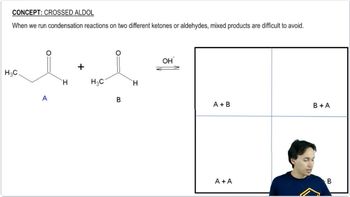
Identify the reaction type: This is a base-catalyzed aldol condensation followed by dehydration. Aldol condensations involve the formation of a β-hydroxy carbonyl compound, which can then undergo dehydration to form an α,β-unsaturated carbonyl compound.
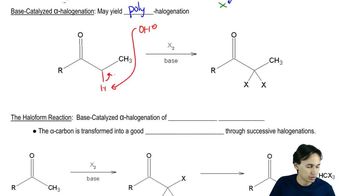
Deprotonation of the α-hydrogen: In the presence of a base (e.g., hydroxide ion, OH⁻), the α-hydrogen of acetaldehyde (CH₃CHO) is removed to form an enolate ion. The enolate ion is stabilized by resonance, with the negative charge delocalized between the oxygen and the α-carbon.
Nucleophilic attack by the enolate: The enolate ion acts as a nucleophile and attacks the carbonyl carbon of 2,2-dimethylpropanal ((CH₃)₃CCHO). This forms a new carbon-carbon bond, resulting in a β-hydroxy intermediate.
Dehydration of the β-hydroxy intermediate: Under basic conditions, the β-hydroxy compound undergoes elimination of water (dehydration). This step involves the removal of a hydroxide ion (OH⁻) and a proton (H⁺) from adjacent carbons, leading to the formation of a double bond between the α and β carbons.
Final product: The result is an α,β-unsaturated carbonyl compound, where the double bond is conjugated with the carbonyl group, providing stability to the product.
Verified video answer for a similar problem:
This video solution was recommended by our tutors as helpful for the problem above
Video duration:
4m
Play a video:
Was this helpful?
Key Concepts
Here are the essential concepts you must grasp in order to answer the question correctly.
Base-Catalyzed Condensation
Base-catalyzed condensation reactions involve the formation of a new bond between two carbonyl compounds, facilitated by a base. The base deprotonates an alpha hydrogen, generating a nucleophile that attacks the carbonyl carbon of another molecule, leading to the formation of a β-hydroxy carbonyl compound. This intermediate can then undergo dehydration to yield an α,β-unsaturated carbonyl compound.
The aldol reaction is a key mechanism in organic chemistry where two aldehydes or ketones react in the presence of a base to form a β-hydroxy aldehyde or ketone. The mechanism involves the formation of an enolate ion from one carbonyl compound, which then attacks the carbonyl carbon of another compound. This reaction is crucial for understanding the formation of larger carbon skeletons and the subsequent dehydration step that leads to unsaturated products.
Dehydration in organic chemistry refers to the elimination of water from a compound, often occurring after the formation of an intermediate. In the context of aldol reactions, after the formation of the β-hydroxy carbonyl compound, dehydration results in the formation of a double bond, yielding an α,β-unsaturated carbonyl compound. This step is essential for driving the reaction towards more stable products and is often facilitated by heat or the presence of an acid or base.