Starting with an alkyl halide, how could the following compounds be prepared? b. 1-methoxybutane
Verified step by step guidance
1
Step 1: Identify the starting material. The problem specifies an alkyl halide as the starting material. For 1-methoxybutane, the alkyl halide should be 1-bromobutane or 1-chlorobutane, as these contain the butane backbone with a halogen at the first carbon.
Step 2: Choose the appropriate reaction mechanism. To prepare 1-methoxybutane, a substitution reaction (SN2 mechanism) is ideal because it involves the replacement of the halogen with a methoxy group (-OCH₃). SN2 reactions work well with primary alkyl halides like 1-bromobutane.
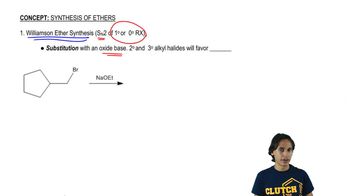
Step 3: Select the nucleophile. The nucleophile in this reaction will be methoxide ion (CH₃O⁻), which can be generated by dissolving methanol (CH₃OH) in a strong base like sodium hydroxide (NaOH) or sodium methoxide (NaOCH₃).
Step 4: Set up the reaction conditions. Combine the alkyl halide (e.g., 1-bromobutane) with the methoxide ion in an appropriate solvent, such as methanol. Ensure the reaction is carried out under conditions favoring the SN2 mechanism, such as a polar aprotic solvent and low steric hindrance.
Step 5: Allow the reaction to proceed. The methoxide ion will attack the carbon bonded to the halogen in a backside attack, displacing the halogen and forming 1-methoxybutane. After the reaction is complete, purify the product using techniques like distillation or extraction.
Verified video answer for a similar problem:
This video solution was recommended by our tutors as helpful for the problem above
Video duration:
3m
Play a video:
Was this helpful?
Key Concepts
Here are the essential concepts you must grasp in order to answer the question correctly.
Alkyl Halides
Alkyl halides are organic compounds containing a carbon atom bonded to a halogen atom (such as chlorine, bromine, or iodine). They serve as versatile intermediates in organic synthesis, allowing for various reactions, including nucleophilic substitutions and eliminations. Understanding their reactivity is crucial for designing pathways to synthesize other compounds, such as ethers.
Nucleophilic substitution reactions involve the replacement of a leaving group (like a halogen) in an alkyl halide with a nucleophile. This process can occur via two main mechanisms: SN1 (unimolecular) and SN2 (bimolecular). The choice of mechanism affects the reaction rate and stereochemistry of the product, which is essential for synthesizing compounds like 1-methoxybutane.
Nucleophiles and Electrophiles can react in Substitution Reactions.
Ethers and Their Synthesis
Ethers are organic compounds characterized by an oxygen atom bonded to two alkyl or aryl groups. They can be synthesized through various methods, including the reaction of alkyl halides with alcohols or alkoxides. In the case of 1-methoxybutane, the synthesis involves the nucleophilic attack of methanol on an appropriate alkyl halide, highlighting the importance of understanding ether formation in organic chemistry.