Predict the product that would form when a Grignard reagent is prepared in the presence of deuterated water.
Verified step by step guidance
1
Understand the nature of a Grignard reagent: A Grignard reagent is typically an organomagnesium compound with the general formula RMgX, where R is an organic group and X is a halogen. It is highly reactive and acts as a nucleophile.
Recognize the role of deuterated water: Deuterated water (D₂O) is water in which the hydrogen atoms are replaced with deuterium, a heavier isotope of hydrogen. It is often used in reactions to trace the incorporation of deuterium into organic molecules.
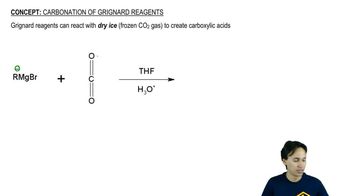
Consider the reactivity of Grignard reagents with water: Grignard reagents are very sensitive to moisture and react with water to form hydrocarbons. In the presence of deuterated water, the Grignard reagent will react to replace the magnesium halide with a deuterium atom.
Predict the product formation: When a Grignard reagent reacts with deuterated water, the organic group (R) will be protonated by the deuterium from D₂O, resulting in the formation of a deuterated hydrocarbon (R-D).
Write the chemical equation: Represent the reaction using a chemical equation. For example, if the Grignard reagent is CH₃MgBr, the reaction with D₂O will yield CH₃D and Mg(OD)Br. Use MathML to encode the chemical equation:
Verified video answer for a similar problem:
This video solution was recommended by our tutors as helpful for the problem above
Play a video:
Was this helpful?
Key Concepts
Here are the essential concepts you must grasp in order to answer the question correctly.
Grignard Reagent
A Grignard reagent is an organomagnesium compound typically represented as RMgX, where R is an organic group and X is a halogen. It is highly reactive and used in organic synthesis to form carbon-carbon bonds. Grignard reagents are sensitive to moisture and react with water to form hydrocarbons.
Deuterated water (D2O) is water in which the hydrogen atoms are replaced with deuterium, a heavier isotope of hydrogen. In chemical reactions, deuterium can replace hydrogen in organic compounds, allowing for isotopic labeling and tracking of reaction pathways. It behaves similarly to regular water but with distinct isotopic properties.
The reaction mechanism involves the interaction between the Grignard reagent and deuterated water. Grignard reagents react with water to form hydrocarbons, replacing the magnesium halide with a hydrogen atom. In the presence of deuterated water, the hydrogen atom is replaced by deuterium, resulting in the formation of a deuterated hydrocarbon.