
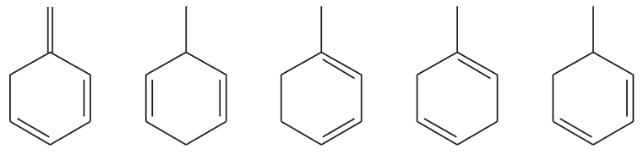
Rank each group of compounds in order of increasing heat of hydrogenation. (b)
Verified step by step guidance
1
Identify the compounds in the group and note the number of double bonds in each structure. The heat of hydrogenation is directly related to the number of double bonds present, as each double bond contributes to the overall energy released during hydrogenation.
Consider the degree of conjugation in the compounds. Conjugated double bonds (alternating single and double bonds) are more stable than isolated double bonds, and thus, compounds with conjugated systems will have a lower heat of hydrogenation compared to those with isolated double bonds.
Analyze the ring strain in the compounds. Smaller rings (e.g., cyclopentene) have higher ring strain compared to larger rings (e.g., cyclohexene). Higher ring strain increases the heat of hydrogenation.
Rank the compounds based on the number of double bonds, degree of conjugation, and ring strain. Compounds with fewer double bonds, more conjugation, and less ring strain will have a lower heat of hydrogenation.
For the given group of compounds, arrange them in order of increasing heat of hydrogenation by comparing their structural features as described in the previous steps.
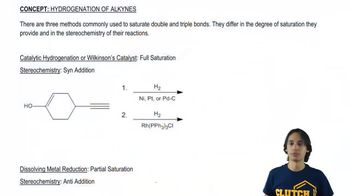
Verified video answer for a similar problem:
This video solution was recommended by our tutors as helpful for the problem above
Video duration:
9m
Play a video:
Was this helpful?
Key Concepts
Here are the essential concepts you must grasp in order to answer the question correctly.
Heat of Hydrogenation
The heat of hydrogenation is the amount of energy released when an alkene or alkyne is hydrogenated to form an alkane. It is a measure of the stability of the unsaturated compound; more stable compounds release less heat upon hydrogenation. Thus, compounds with higher degrees of substitution or resonance stabilization will have lower heats of hydrogenation compared to less stable, more strained structures.
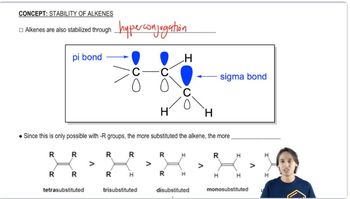
The stability of alkenes is influenced by the degree of substitution on the double bond. Tetrasubstituted alkenes are more stable than trisubstituted, which are more stable than disubstituted, and so on. This stability arises from hyperconjugation and the inductive effect of alkyl groups, which help to stabilize the double bond, leading to lower heats of hydrogenation.
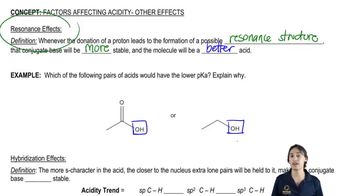
Resonance effects occur when a molecule can be represented by two or more valid Lewis structures, leading to delocalization of electrons. In the context of the compounds shown, resonance can stabilize certain structures, making them less reactive and thus lowering their heat of hydrogenation. Compounds with significant resonance stabilization will typically have lower heats of hydrogenation compared to those without such stabilization.