

Bromination of buta-1,3-diene with a single equivalent of Br2 can give either of two products. (a) Which of these products (A or B) would you predict to be more stable? Justify your answer.
Verified step by step guidance
1
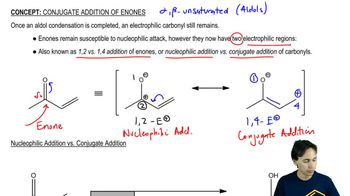
Identify the two possible products (A and B) formed from the bromination of buta-1,3-diene. These products arise from either 1,2-addition or 1,4-addition of Br₂ to the conjugated diene system.
Analyze the structure of each product. For the 1,2-addition product (A), the bromine atoms are added to the first and second carbons of the diene. For the 1,4-addition product (B), the bromine atoms are added to the first and fourth carbons, resulting in a conjugated double bond in the product.
Recall that stability in organic molecules is influenced by factors such as conjugation, hyperconjugation, and steric effects. Conjugated systems, where alternating double and single bonds are present, are generally more stable due to delocalization of π-electrons.
Compare the stability of the two products. The 1,4-addition product (B) retains a conjugated π-system, which allows for delocalization of electrons, making it more stable. In contrast, the 1,2-addition product (A) lacks this extended conjugation.
Conclude that product B (from 1,4-addition) is predicted to be more stable than product A (from 1,2-addition) due to the presence of a conjugated π-system in product B, which provides additional stabilization through electron delocalization.
Verified video answer for a similar problem:
This video solution was recommended by our tutors as helpful for the problem above
Video duration:
3m
Play a video:
Was this helpful?
Key Concepts
Here are the essential concepts you must grasp in order to answer the question correctly.
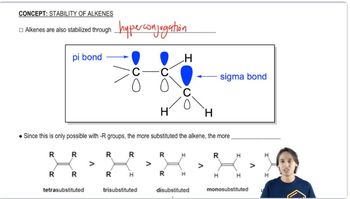
Stability of Alkenes
The stability of alkenes is influenced by the degree of substitution on the double bond. More substituted alkenes are generally more stable due to hyperconjugation and the inductive effect of alkyl groups, which can help to stabilize the double bond. In the case of bromination of buta-1,3-diene, the product with the more substituted double bond will typically be the more stable isomer.
Regioselectivity refers to the preference of a chemical reaction to yield one structural isomer over others. In the bromination of buta-1,3-diene, the addition of Br₂ can lead to two different products depending on which carbon atoms the bromine atoms add to. Understanding the regioselectivity helps predict which product will be formed preferentially based on the stability of the resulting alkene.
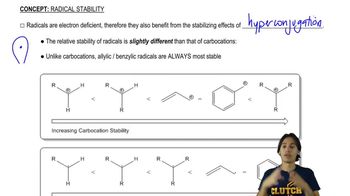
Resonance stabilization occurs when a molecule can be represented by two or more valid Lewis structures, leading to a delocalization of electrons. In the case of buta-1,3-diene, the presence of conjugated double bonds allows for resonance, which can stabilize certain products formed during bromination. The product that benefits more from resonance stabilization will generally be the more stable one.