Textbook Question
One of the following compounds undergoes electrophilic aromatic substitution predominantly at C-3, and one undergoes electrophilic aromatic substitution predominantly at C-4. Which is which?
757
views

 Bruice 8th EditionCh. 19 - More About Amines • Reactions of Heterocyclic CompoundsProblem 30a,b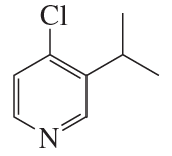
 Verified step by step guidance
 02:49
02:49
 01:40
01:40 2:02
2:02One of the following compounds undergoes electrophilic aromatic substitution predominantly at C-3, and one undergoes electrophilic aromatic substitution predominantly at C-4. Which is which?
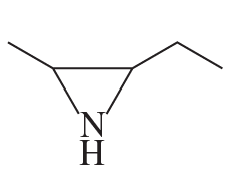
Benzene undergoes electrophilic aromatic substitution reactions with aziridines in the presence of a Lewis acid such as AlCl3.
a. What are the major and minor products of the following reaction?
b. Would you expect epoxides to undergo similar reactions?
Name the following:
c.
What products are obtained when the following tertiary amines react with hydrogen peroxide followed by heat?
a.
b.
A tertiary amine reacts with hydrogen peroxide to form a tertiary amine oxide.
Tertiary amine oxides undergo a reaction similar to the Hofmann elimination reaction (Section 10.10), called a Cope elimination. In this reaction, a tertiary amine oxide, rather than a quaternary ammonium ion, undergoes elimination. A strong base is not needed for a Cope elimination because the amine oxide acts as its own base.
Does the Cope elimination have an alkene-like transition state or a carbanion-like transition state?
Pyrrole reacts with excess para-(N,N-dimethylamino)benzaldehyde to form a highly colored compound. Draw the structure of the colored compound.