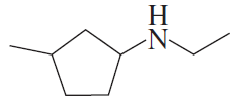
Give a systematic name and a common name (if it has one) for each of the following amines and indicate whether each is a primary, secondary, or tertiary amine: f.
Verified step by step guidance
1
Step 1: Identify the structure of the given amine. Look at the carbon chain attached to the nitrogen atom and determine the number of alkyl or aryl groups bonded to the nitrogen atom. This will help classify the amine as primary (1°), secondary (2°), or tertiary (3°).
Step 2: For systematic naming, identify the longest carbon chain attached to the nitrogen atom. Name this chain as the parent alkane, replacing the '-e' ending with '-amine' to indicate the presence of an amine group.
Step 3: Number the carbon chain such that the carbon attached to the nitrogen atom gets the lowest possible number. If there are substituents on the chain, name and number them accordingly.
Step 4: For the common name (if applicable), list the alkyl groups attached to the nitrogen atom in alphabetical order, followed by the word 'amine'. For example, if there are two methyl groups and one ethyl group attached to the nitrogen, the common name would be 'ethyl dimethylamine'.
Step 5: Indicate whether the amine is primary, secondary, or tertiary based on the number of carbon groups attached to the nitrogen atom. A primary amine has one carbon group, a secondary amine has two, and a tertiary amine has three.
Verified video answer for a similar problem:
This video solution was recommended by our tutors as helpful for the problem above
Video duration:
7m
Play a video:
Was this helpful?
Key Concepts
Here are the essential concepts you must grasp in order to answer the question correctly.
Amines
Amines are organic compounds derived from ammonia (NH3) by replacing one or more hydrogen atoms with alkyl or aryl groups. They are classified based on the number of carbon-containing groups attached to the nitrogen atom: primary amines have one carbon group, secondary amines have two, and tertiary amines have three. Understanding the structure of amines is crucial for naming them systematically and identifying their classification.
Systematic naming of amines follows the IUPAC nomenclature rules, which involve identifying the longest carbon chain attached to the nitrogen and using the suffix '-amine' for the compound. The position of the amine group is indicated by a number corresponding to its location on the carbon chain. This systematic approach ensures clarity and consistency in naming organic compounds.
Common names for amines often arise from their structure and historical usage, and they may not follow strict IUPAC rules. For example, methylamine and ethylamine are common names for primary amines derived from ammonia. Recognizing these common names is important for understanding the broader context of amine compounds and their applications in organic chemistry.