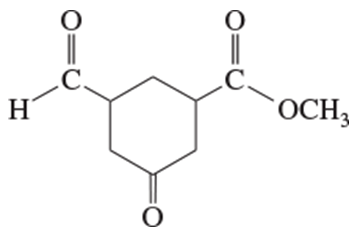
Predict the products you would expect from the reaction of LiAlH4 followed by hydrolysis with the following compounds. You may assume that these reactions take place in methanol as the solvent. (e)
Verified step by step guidance
1
Step 1: Analyze the structure of the compound provided. The molecule contains three carbonyl groups: an aldehyde (-CHO), a ketone (C=O), and an ester (-COOCH3). Each of these functional groups reacts differently with LiAlH4.
Step 2: Understand the role of LiAlH4 (Lithium Aluminum Hydride). It is a strong reducing agent that reduces aldehydes, ketones, and esters to their corresponding alcohols. The reaction typically involves the addition of hydride ions (H-) to the carbonyl carbon.
Step 3: Predict the reduction of the aldehyde group (-CHO). LiAlH4 will reduce the aldehyde to a primary alcohol (-CH2OH). This occurs because the hydride ion attacks the carbonyl carbon, followed by protonation during hydrolysis.
Step 4: Predict the reduction of the ketone group (C=O). LiAlH4 will reduce the ketone to a secondary alcohol (-CHOH). The hydride ion attacks the carbonyl carbon, and hydrolysis provides the proton to complete the alcohol formation.
Step 5: Predict the reduction of the ester group (-COOCH3). LiAlH4 reduces esters to primary alcohols. The ester group will be cleaved, producing methanol (CH3OH) and a primary alcohol derived from the remaining carbon chain. Hydrolysis ensures the completion of the reaction.
Verified video answer for a similar problem:
This video solution was recommended by our tutors as helpful for the problem above
Video duration:
2m
Play a video:
Was this helpful?
Key Concepts
Here are the essential concepts you must grasp in order to answer the question correctly.
Lithium Aluminum Hydride (LiAlH4) Reactivity
LiAlH4 is a strong reducing agent commonly used in organic chemistry to reduce carbonyl compounds, such as aldehydes and ketones, to their corresponding alcohols. It donates hydride ions (H-) to the electrophilic carbon of the carbonyl group, facilitating the conversion of the carbonyl compound into an alcohol. Understanding its reactivity is crucial for predicting the products of reactions involving carbonyl-containing compounds.
After the reduction of a carbonyl compound by LiAlH4, the resulting alkoxide intermediate can undergo hydrolysis when treated with water or an alcohol like methanol. This process involves the protonation of the alkoxide to form the corresponding alcohol. Recognizing the hydrolysis step is essential for determining the final products of the reaction sequence.
The choice of solvent can significantly influence the outcome of organic reactions. In this case, methanol serves both as a solvent and as a reactant during hydrolysis. Understanding how solvents can stabilize intermediates, affect reaction rates, and participate in reactions is important for accurately predicting the products of the reaction sequence involving LiAlH4 and hydrolysis.