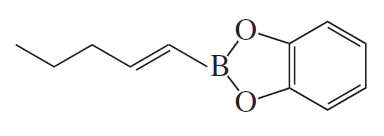
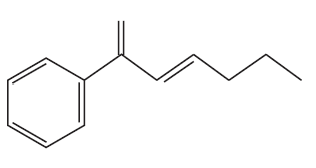
What aryl or vinylic halides would you use to synthesize the following compounds, using the alkenylorganoboron compound shown here? c.
Verified step by step guidance
1
Step 1: Analyze the alkenylorganoboron compound provided in the image. The compound contains a boronic ester group attached to an alkenyl group, which can participate in Suzuki coupling reactions. Suzuki coupling is a palladium-catalyzed cross-coupling reaction between an organoboron compound and an aryl or vinylic halide.
Step 2: Examine the target compound shown in the image. The target molecule contains a conjugated system with an aryl group and an extended alkenyl chain. This suggests that the reaction involves coupling the alkenylorganoboron compound with an appropriate halide to form the desired structure.
Step 3: Identify the halide required for the coupling reaction. The target molecule has a phenyl group attached to the alkenyl chain. To achieve this, an aryl halide, such as bromobenzene or iodobenzene, can be used as the coupling partner.
Step 4: Consider the reaction conditions. The Suzuki coupling typically requires a palladium catalyst (e.g., Pd(PPh3)4), a base (e.g., K2CO3 or NaOH), and a solvent such as tetrahydrofuran (THF) or water. These conditions facilitate the formation of the C-C bond between the alkenylorganoboron compound and the aryl halide.
Step 5: Summarize the synthesis. To synthesize the target compound, use the alkenylorganoboron compound provided in the image and an aryl halide, such as bromobenzene or iodobenzene, under Suzuki coupling conditions. This will result in the formation of the desired conjugated system with the phenyl group attached to the alkenyl chain.
Verified video answer for a similar problem:
This video solution was recommended by our tutors as helpful for the problem above
Video duration:
4m
Play a video:
Was this helpful?
Key Concepts
Here are the essential concepts you must grasp in order to answer the question correctly.
Suzuki Coupling Reaction
The Suzuki coupling reaction is a widely used method in organic chemistry for forming carbon-carbon bonds. It involves the reaction of an aryl or vinylic halide with an alkenylorganoboron compound in the presence of a palladium catalyst and a base. This reaction is particularly valuable for synthesizing complex organic molecules, allowing for the introduction of various functional groups.
Aryl halides are compounds where a halogen atom is bonded to an aromatic ring, while vinylic halides have a halogen atom attached to a carbon-carbon double bond. Both types of halides are important in organic synthesis, especially in reactions like the Suzuki coupling, where they serve as electrophiles that react with nucleophilic organoboron compounds to form new carbon-carbon bonds.
Alkenylorganoboron compounds are organoboron species that contain a carbon-carbon double bond. They act as nucleophiles in the Suzuki reaction, reacting with aryl or vinylic halides to form new alkenes. The versatility of these compounds allows for the synthesis of a wide range of products, making them essential in the development of pharmaceuticals and advanced materials.