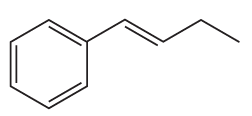
Show how the Suzuki and/or Heck reactions can be used to prepare the following compounds: a.
Verified step by step guidance
1
Step 1: Analyze the target molecule. The compound contains a phenyl group attached to an acetyl group (CH3CO-) and a styrene-like structure with a cyclopentyl substituent. This suggests the use of cross-coupling reactions like Suzuki or Heck to form the carbon-carbon bonds.
Step 2: Identify the key bond-forming steps. The double bond between the phenyl group and the styrene-like structure can be formed using the Heck reaction, which involves the coupling of an aryl halide with an alkene in the presence of a palladium catalyst.
Step 3: Select the starting materials for the Heck reaction. Use an aryl halide, such as acetophenone bromide (CH3COC6H4Br), and an alkene, such as cyclopentyl vinyl compound (CH2=CH-cyclopentyl). These will undergo coupling to form the desired product.
Step 4: Describe the reaction conditions. The Heck reaction typically requires a palladium catalyst (e.g., Pd(OAc)2), a base (e.g., triethylamine or K2CO3), and a solvent like DMF or toluene. Heat the reaction mixture to promote coupling.
Step 5: Verify the product formation. After the Heck reaction, the product should be the desired compound with the phenyl group, acetyl group, and styrene-like structure with the cyclopentyl substituent. Purify the product using techniques like column chromatography or recrystallization.
Verified video answer for a similar problem:
This video solution was recommended by our tutors as helpful for the problem above
Video duration:
4m
Play a video:
Was this helpful?
Key Concepts
Here are the essential concepts you must grasp in order to answer the question correctly.
Suzuki Reaction
The Suzuki reaction is a cross-coupling reaction that allows for the formation of carbon-carbon bonds between aryl or vinyl boronic acids and halides. This reaction is facilitated by palladium catalysts and is particularly useful for synthesizing biaryl compounds, which are prevalent in pharmaceuticals and organic materials. Understanding the mechanism, which involves oxidative addition, transmetalation, and reductive elimination, is crucial for applying this reaction effectively.
The Heck reaction is another type of palladium-catalyzed cross-coupling reaction that involves the coupling of aryl halides with alkenes to form substituted alkenes. This reaction is valuable for constructing complex organic molecules and is widely used in the synthesis of pharmaceuticals and agrochemicals. A solid grasp of the reaction conditions, such as the choice of base and solvent, is essential for optimizing yields and selectivity.
In organic synthesis, understanding functional group compatibility is vital for predicting the outcomes of reactions. Different functional groups can influence the reactivity and selectivity of reactions, such as the Suzuki and Heck reactions. For instance, electron-withdrawing or electron-donating groups can affect the stability of intermediates and the overall reaction pathway, making it important to consider these effects when designing synthetic routes for target compounds.