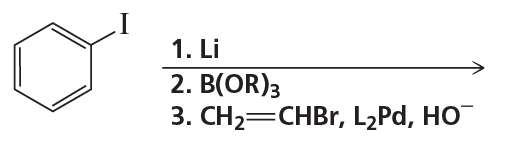
What are the products of the following reactions? d.
Verified step by step guidance
1
Step 1: Analyze the starting material and reagents. The starting material is an aryl iodide (1-iodo-4-ethylbenzene). The reaction involves three steps: (1) treatment with lithium (Li), (2) reaction with a borate ester (B(OR)3), and (3) a Suzuki coupling reaction with a vinyl bromide in the presence of Pd(PPh3)4 and Na2CO3 under heat.
Step 2: In the first step, lithium reacts with the aryl iodide to form an aryl lithium intermediate. This is a nucleophilic species where the iodine atom is replaced by lithium.
Step 3: In the second step, the aryl lithium intermediate reacts with the borate ester (B(OR)3) to form an aryl boronic ester. This is a key intermediate for Suzuki coupling reactions.
Step 4: In the third step, the aryl boronic ester undergoes a Suzuki coupling reaction with the vinyl bromide. The palladium catalyst (Pd(PPh3)4) facilitates the cross-coupling between the aryl group and the vinyl group, forming a new C-C bond.
Step 5: The final product is a styrene derivative where the aryl group (4-ethylphenyl) is connected to the vinyl group (CH=CH2). This product is formed through the combination of the aryl boronic ester and the vinyl bromide.
Verified video answer for a similar problem:
This video solution was recommended by our tutors as helpful for the problem above
Video duration:
4m
Play a video:
Was this helpful?
Key Concepts
Here are the essential concepts you must grasp in order to answer the question correctly.
Suzuki Coupling Reaction
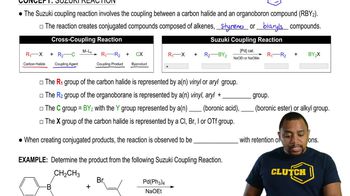
The Suzuki coupling reaction is a widely used method in organic chemistry for forming carbon-carbon bonds. It involves the reaction of a boronic acid or boronate ester with an organic halide in the presence of a palladium catalyst and a base. This reaction is particularly valuable for synthesizing biaryl compounds and is characterized by its mild reaction conditions and high functional group tolerance.
Organoboron compounds, such as boronic acids and boronate esters, are key intermediates in various organic reactions, including the Suzuki reaction. They contain a boron atom bonded to a carbon atom, which can participate in nucleophilic substitution reactions. Their ability to form stable complexes with transition metals makes them essential for cross-coupling reactions, facilitating the formation of new carbon-carbon bonds.
Palladium catalysis plays a crucial role in many cross-coupling reactions, including the Suzuki reaction. Palladium serves as a catalyst that facilitates the oxidative addition of the organic halide and the subsequent reductive elimination to form the desired product. The use of palladium allows for lower activation energy and increased reaction rates, making it a preferred choice in synthetic organic chemistry.