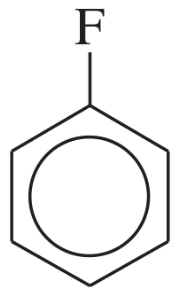
Step 1: Analyze compound (i). The structure shows a benzene ring with a bromine atom attached. This is a monosubstituted benzene derivative. The naming convention for such compounds is to use 'bromo-' as the prefix and 'benzene' as the base name.
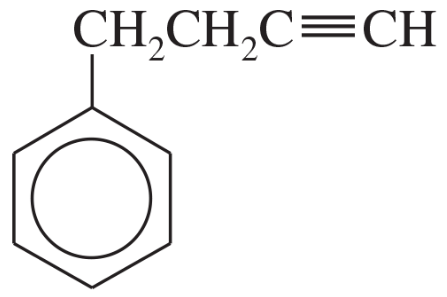
Step 2: Analyze compound (ii). The structure shows a benzene ring with a methyl group (-CH3) and an ethynyl group (-C≡CH) attached. The methyl group is at the first position, and the ethynyl group is at the second position. The compound is named as a derivative of toluene (methylbenzene), with the ethynyl group specified as a substituent.
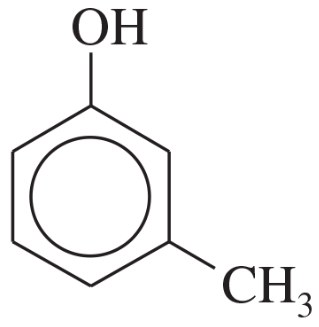
Step 3: Analyze compound (iii). The structure shows a benzene ring with a hydroxyl group (-OH) and a methyl group (-CH3) attached. The hydroxyl group takes priority in naming, so the compound is named as a derivative of phenol. The methyl group is specified as a substituent, and its position is indicated.
Step 4: For all compounds, ensure the substituents are numbered correctly to minimize the locants (position numbers) and follow IUPAC naming rules. For example, the substituent with higher priority (like -OH) should get the lowest possible number.
Step 5: Write the names of the compounds systematically based on the analysis: (i) Bromobenzene, (ii) 1-Methyl-2-ethynylbenzene, (iii) o-Cresol (or 2-Methylphenol).
Verified video answer for a similar problem:
This video solution was recommended by our tutors as helpful for the problem above
Video duration:
3m
Play a video:
Was this helpful?
Key Concepts
Here are the essential concepts you must grasp in order to answer the question correctly.
Nomenclature of Aromatic Compounds
Aromatic compounds, such as benzene and its derivatives, follow specific naming conventions established by IUPAC. The presence of substituents on the benzene ring affects the compound's name, which can include prefixes like 'bromo-' for bromine or 'methyl-' for a methyl group. Understanding the position of substituents (ortho, meta, para) is crucial for accurate naming.
Substituent Effects on Aromatic Rings
Substituents on aromatic rings can influence the reactivity and stability of the compound. Electron-donating groups (EDGs) such as -OH or -CH3 can activate the ring towards electrophilic substitution, while electron-withdrawing groups (EWGs) like -Br can deactivate it. Recognizing these effects is essential for predicting the behavior of the compound in chemical reactions.
Alkenes and Alkynes as Substituents
When naming compounds with alkenes or alkynes as substituents, it is important to identify the longest carbon chain that includes the double or triple bond. The position of the double or triple bond is indicated by the lowest possible number in the name. This understanding is vital for accurately naming compounds that contain both aromatic and unsaturated hydrocarbon features.