
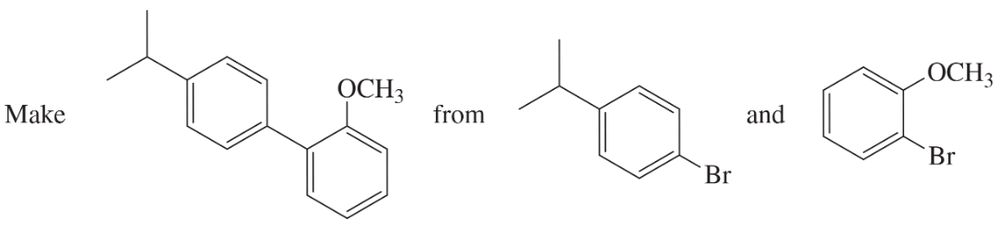
Show how you would use a Suzuki reaction to synthesize the following biaryl compound. As starting materials, you may use the two indicated compounds, plus any additional reagents you need.
Verified step by step guidance
1
Step 1: Identify the two starting materials required for the Suzuki reaction. The Suzuki reaction involves coupling an aryl halide with an organoboron compound in the presence of a palladium catalyst. Based on the target biaryl compound, one starting material should be an aryl halide (e.g., bromobenzene derivative), and the other should be an arylboronic acid or ester.
Step 2: Modify the two indicated compounds to create the necessary functional groups for the Suzuki reaction. For example, if one compound is a benzene derivative, convert it into an aryl halide (e.g., bromobenzene) by halogenation. Similarly, convert the other compound into an arylboronic acid or ester using a reaction such as hydroboration.
Step 3: Set up the Suzuki reaction. Combine the aryl halide and the arylboronic acid in a reaction vessel. Add a palladium catalyst (e.g., Pd(PPh3)4 or PdCl2) and a base (e.g., potassium carbonate or sodium hydroxide) to facilitate the reaction. Use a solvent such as tetrahydrofuran (THF) or ethanol.
Step 4: Allow the reaction to proceed under appropriate conditions. Heat the reaction mixture gently (e.g., 50–80°C) to promote the coupling of the two aryl groups. Monitor the reaction progress using techniques such as thin-layer chromatography (TLC) or gas chromatography (GC).
Step 5: Purify the product. Once the reaction is complete, isolate the biaryl compound by removing the solvent and purifying the product using methods such as recrystallization or column chromatography. Confirm the structure of the biaryl compound using spectroscopic techniques like NMR or IR.
Verified video answer for a similar problem:
This video solution was recommended by our tutors as helpful for the problem above
Video duration:
9m
Play a video:
Was this helpful?
Key Concepts
Here are the essential concepts you must grasp in order to answer the question correctly.
Suzuki Reaction
The Suzuki reaction is a widely used cross-coupling reaction in organic chemistry that allows for the formation of biaryl compounds. It involves the coupling of an aryl or vinyl boronic acid with an aryl halide in the presence of a palladium catalyst and a base. This reaction is particularly valued for its ability to create carbon-carbon bonds with high selectivity and efficiency, making it essential for synthesizing complex organic molecules.
Aryl Halides
Aryl halides are organic compounds that contain a halogen atom (such as chlorine, bromine, or iodine) bonded to an aromatic ring. They serve as key substrates in various organic reactions, including the Suzuki reaction. The reactivity of aryl halides is influenced by the nature of the halogen and the electronic properties of the aromatic system, which can affect the efficiency of the coupling process.
Boronic Acids
Boronic acids are organic compounds containing a boron atom bonded to a hydroxyl group and two organic groups. In the context of the Suzuki reaction, boronic acids act as nucleophiles that react with aryl halides to form biaryl compounds. Their ability to form stable complexes with transition metals, such as palladium, is crucial for facilitating the cross-coupling reaction, making them indispensable in synthetic organic chemistry.