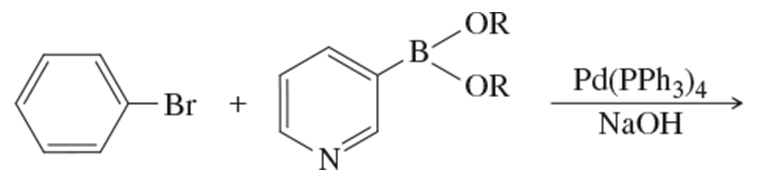
What products would you expect from the following Suzuki coupling reactions? (b)
Verified step by step guidance
1
Step 1: Recognize that this is a Suzuki coupling reaction, which involves the cross-coupling of an aryl or vinyl halide (in this case, bromobenzonorbornene) with an organoboron compound (in this case, pyridylboronic ester) in the presence of a palladium catalyst and a base.
Step 2: Identify the two key components: (1) the aryl halide (bromobenzonorbornene) and (2) the organoboron compound (pyridylboronic ester). The palladium catalyst (Pd(PPh₃)₄) facilitates the coupling, and NaOH serves as the base to activate the boronic ester.
Step 3: Understand the mechanism. The reaction proceeds via oxidative addition of the aryl halide to the palladium catalyst, followed by transmetalation with the organoboron compound, and finally reductive elimination to form the new C-C bond.
Step 4: Predict the product. The bromine atom on the bromobenzonorbornene is replaced by the pyridyl group from the boronic ester, resulting in a biaryl product where the pyridyl group is directly bonded to the benzonorbornene ring.
Step 5: Verify the regioselectivity and stereochemistry. Since the reaction involves sp² hybridized carbons, the product will be planar at the site of the new bond. The pyridyl group will attach to the position where the bromine was originally located.
Verified video answer for a similar problem:
This video solution was recommended by our tutors as helpful for the problem above
Video duration:
3m
Play a video:
Was this helpful?
Key Concepts
Here are the essential concepts you must grasp in order to answer the question correctly.
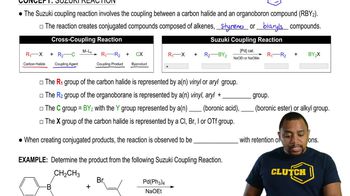
Suzuki Coupling Reaction
The Suzuki coupling reaction is a widely used method in organic chemistry for forming carbon-carbon bonds. It involves the reaction of an organoboron compound with a halogenated organic compound in the presence of a palladium catalyst and a base. This reaction is particularly valuable for synthesizing biaryl compounds and is favored for its mild reaction conditions and high functional group tolerance.
Organoboron compounds, such as boronic acids and boronate esters, are key reactants in Suzuki coupling reactions. They contain a boron atom bonded to a carbon atom, which can participate in nucleophilic attack during the coupling process. The stability and reactivity of these compounds make them essential for forming diverse organic molecules, especially in pharmaceutical and materials chemistry.
Palladium catalysis is crucial in facilitating the Suzuki coupling reaction. Palladium complexes, often in the form of Pd(0) or Pd(II), serve as catalysts that lower the activation energy required for the reaction to proceed. The palladium catalyst enables the oxidative addition of the halide to the palladium center, followed by transmetalation with the organoboron compound, ultimately leading to the formation of the desired product.