What products would you expect from the following Suzuki coupling reactions? (a)
Verified step by step guidance
1
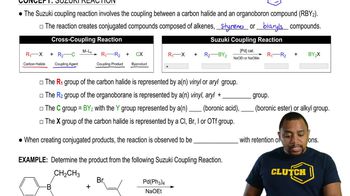
Step 1: Recognize that this is a Suzuki coupling reaction, which involves the cross-coupling of an aryl halide (in this case, a bromobenzene derivative) with an organoboron compound (in this case, a phenylboronic acid derivative) in the presence of a palladium catalyst and a base.
Step 2: Identify the two reactants. The aryl halide is 4-bromo-1-isopropylbenzene, and the organoboron compound is 4-methylphenylboronic acid. The palladium catalyst (Pd(OAc)₂) and base (K₃PO₄) facilitate the reaction.
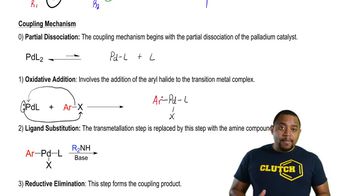
Step 3: Understand the mechanism. The palladium catalyst first undergoes oxidative addition with the aryl halide, forming a palladium complex. The organoboron compound then reacts with the palladium complex via transmetalation, transferring the aryl group from boron to palladium.
Step 4: The final step is reductive elimination, where the two aryl groups (one from the aryl halide and one from the organoboron compound) couple together, forming a new carbon-carbon bond. This results in the formation of a biaryl product.
Step 5: Combine the two aryl groups. The product of this reaction will be 4-isopropyl-1-(4-methylphenyl)benzene, where the isopropyl group and methyl group remain intact on their respective benzene rings.
Verified video answer for a similar problem:
This video solution was recommended by our tutors as helpful for the problem above
Video duration:
3m
Play a video:
Was this helpful?
Key Concepts
Here are the essential concepts you must grasp in order to answer the question correctly.
Suzuki Coupling Reaction
The Suzuki coupling reaction is a widely used method in organic chemistry for forming carbon-carbon bonds. It involves the reaction of an organoboron compound with a halogenated organic compound in the presence of a palladium catalyst and a base. This reaction is particularly valuable for synthesizing biaryl compounds, which are important in pharmaceuticals and materials science.
Palladium catalysis is crucial in many cross-coupling reactions, including the Suzuki reaction. Palladium serves as a catalyst that facilitates the oxidative addition of the halide to the palladium center, followed by transmetalation with the organoboron compound. The use of palladium allows for milder reaction conditions and higher selectivity in forming desired products.
Transmetalation is a key step in the Suzuki coupling mechanism where the organoboron compound transfers its organic group to the palladium complex. This step is essential for forming the new carbon-carbon bond. The efficiency of transmetalation can be influenced by the choice of base and the nature of the organoboron compound, impacting the overall yield of the reaction.