Furan and maleimide undergo a Diels–Alder reaction at 25 °C to give the endo isomer of the product. When the reaction takes place at 90 °C, however, the major product is the exo isomer. Further study shows that the endo isomer of the product isomerizes to the exo isomer at 90 °C. b. Which isomer of the product would you usually expect from this reaction? Explain why this isomer is usually favored.
Verified step by step guidance
1
Step 1: Understand the Diels–Alder reaction mechanism. The Diels–Alder reaction is a [4+2] cycloaddition between a conjugated diene (furan) and a dienophile (maleimide). This reaction forms a six-membered ring and is stereospecific, meaning the stereochemistry of the reactants influences the stereochemistry of the product.
Step 2: Analyze the endo and exo isomers. The endo isomer is typically favored in Diels–Alder reactions due to secondary orbital interactions. These interactions occur between the π-electrons of the diene and the π* orbitals of the dienophile, stabilizing the transition state and favoring the endo product.
Step 3: Consider the temperature effect. At 25 °C, the reaction is kinetically controlled, favoring the endo isomer due to the lower activation energy and stabilizing secondary orbital interactions. At 90 °C, the reaction becomes thermodynamically controlled, allowing the endo isomer to isomerize to the exo isomer, which is more stable due to steric factors.
Step 4: Explain why the endo isomer is usually favored. Under typical reaction conditions (lower temperatures), the endo isomer is favored because the reaction is kinetically controlled, and the secondary orbital interactions stabilize the transition state leading to the endo product.
Step 5: Summarize the findings. The endo isomer is the expected product under standard conditions due to kinetic control and secondary orbital interactions. However, at higher temperatures, the exo isomer becomes the major product due to thermodynamic control and its greater stability.
Verified video answer for a similar problem:
This video solution was recommended by our tutors as helpful for the problem above
Video duration:
5m
Play a video:
0 Comments
Key Concepts
Here are the essential concepts you must grasp in order to answer the question correctly.
Diels–Alder Reaction
The Diels–Alder reaction is a cycloaddition reaction between a conjugated diene and a dienophile, forming a six-membered ring. This reaction is a key method in organic synthesis due to its ability to create complex cyclic structures efficiently. The stereochemistry of the products can vary based on reaction conditions, such as temperature, which influences the stability of the resulting isomers.
In the context of the Diels–Alder reaction, endo and exo refer to the relative orientation of substituents on the newly formed ring. The endo isomer has substituents oriented towards the larger bridge of the bicyclic structure, while the exo isomer has them oriented away. Generally, the endo isomer is favored at lower temperatures due to secondary orbital interactions, while the exo isomer becomes more stable at higher temperatures.
Isomerization is the process by which one isomer is transformed into another, often involving the rearrangement of bonds. In the case of the Diels–Alder reaction, the endo isomer can isomerize to the exo isomer upon heating. This temperature-dependent behavior is crucial for understanding product distribution and stability, as the exo isomer is typically more thermodynamically stable at elevated temperatures.


 5:00 minutes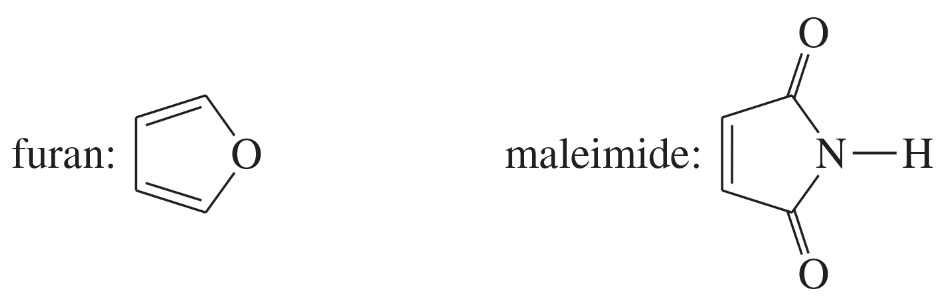
 Verified step by step guidance
 04:02
04:02