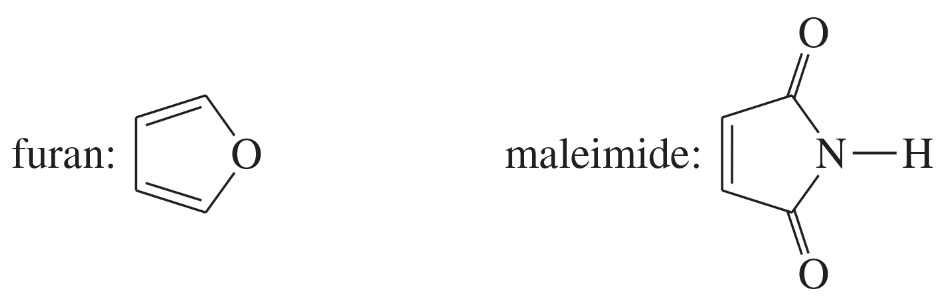
Furan and maleimide undergo a Diels–Alder reaction at 25 °C to give the endo isomer of the product. When the reaction takes place at 90 °C, however, the major product is the exo isomer. Further study shows that the endo isomer of the product isomerizes to the exo isomer at 90 °C. a. Draw and label the endo and exo isomers of the Diels–Alder adduct of furan and maleimide.
Verified step by step guidance
1
Step 1: Understand the Diels–Alder reaction mechanism. The Diels–Alder reaction is a [4+2] cycloaddition reaction where a conjugated diene (furan) reacts with a dienophile (maleimide) to form a cyclic adduct. The reaction can produce two stereoisomers: the endo and exo products.
Step 2: Analyze the structures of furan and maleimide. Furan is a five-membered aromatic ring containing oxygen, and maleimide is a cyclic compound with a double bond and two carbonyl groups. Maleimide acts as the dienophile in this reaction.
Step 3: Draw the endo isomer. In the endo product, the substituents on the dienophile (the carbonyl groups of maleimide) are oriented towards the π-electron cloud of the diene (furan). This is due to secondary orbital interactions, which stabilize the endo product at lower temperatures.
Step 4: Draw the exo isomer. In the exo product, the substituents on the dienophile (the carbonyl groups of maleimide) are oriented away from the π-electron cloud of the diene. This isomer becomes the major product at higher temperatures due to thermodynamic stability.
Step 5: Label the structures. Clearly label the endo and exo isomers in your drawing. Indicate the orientation of the substituents (towards or away from the π-electron cloud) and ensure the cyclic adduct is correctly drawn to reflect the stereochemistry of the reaction.
Verified video answer for a similar problem:
This video solution was recommended by our tutors as helpful for the problem above
Video duration:
2m
Play a video:
Was this helpful?
Key Concepts
Here are the essential concepts you must grasp in order to answer the question correctly.
Diels–Alder Reaction
The Diels–Alder reaction is a [4+2] cycloaddition reaction between a diene and a dienophile, forming a six-membered ring. This reaction is significant in organic synthesis due to its ability to create complex cyclic structures with high stereoselectivity. The reaction can yield different isomers, such as endo and exo, depending on the orientation of substituents in the product.
In the context of the Diels–Alder reaction, stereochemistry refers to the spatial arrangement of atoms in the resulting adduct. The endo isomer has substituents oriented towards the larger π system of the diene, while the exo isomer has them oriented away. This difference in orientation affects the stability and reactivity of the isomers, influencing which isomer predominates under specific conditions.
Isomerization is the process by which one isomer is transformed into another, often involving a change in the arrangement of atoms. In this case, the endo isomer of the Diels–Alder product can isomerize to the exo isomer at elevated temperatures, such as 90 °C. This thermal isomerization is crucial for understanding the stability and reactivity of the products formed in the reaction.