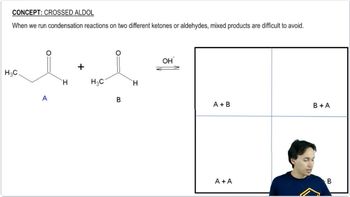
Give the expected products for the aldol condensations of (a) propanal.
Verified step by step guidance
1
Step 1: Understand the aldol condensation reaction. Aldol condensation involves the reaction of an enolate ion (formed from an aldehyde or ketone) with another molecule of aldehyde or ketone, followed by dehydration to form an α,β-unsaturated carbonyl compound.
Step 2: Identify the reactant. In this case, the reactant is propanal (CH₃CH₂CHO), which contains an α-hydrogen necessary for enolate formation.
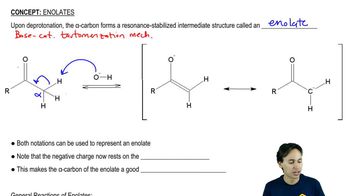
Step 3: Generate the enolate ion. Under basic conditions, the α-hydrogen of propanal is deprotonated to form the enolate ion: \( \text{CH}_3\text{CH}=\text{CH}^- \).
Step 4: Perform the nucleophilic attack. The enolate ion acts as a nucleophile and attacks the carbonyl carbon of another molecule of propanal, forming a β-hydroxy aldehyde intermediate: \( \text{CH}_3\text{CH}(\text{OH})\text{CH}_2\text{CHO} \).
Step 5: Dehydrate the β-hydroxy aldehyde. Under heating or continued basic conditions, the β-hydroxy aldehyde undergoes elimination of water to form the α,β-unsaturated aldehyde product: \( \text{CH}_3\text{CH}=\text{CHCHO} \) (crotonaldehyde).
Verified video answer for a similar problem:
This video solution was recommended by our tutors as helpful for the problem above
Video duration:
2m
Play a video:
Was this helpful?
Key Concepts
Here are the essential concepts you must grasp in order to answer the question correctly.
Aldol Condensation
Aldol condensation is a reaction between aldehydes or ketones that contain at least one alpha-hydrogen. In this process, an enolate ion is formed from one carbonyl compound, which then attacks the carbonyl carbon of another molecule, leading to the formation of a beta-hydroxy aldehyde or ketone. This intermediate can further dehydrate to yield an alpha, beta-unsaturated carbonyl compound.
Propanal, also known as propionaldehyde, is a three-carbon aldehyde with the chemical formula C3H6O. Its structure consists of a carbon chain with a terminal carbonyl group (C=O) and two additional carbon atoms. Understanding the structure of propanal is crucial for predicting the products of its aldol condensation, as the presence of alpha-hydrogens on the second carbon allows for enolate formation.
Enolate ions are formed when a carbonyl compound undergoes deprotonation at the alpha-carbon, resulting in a resonance-stabilized anion. This ion is a key intermediate in aldol reactions, as it acts as a nucleophile that can attack another carbonyl compound. The ability to form enolates is essential for understanding the reactivity of aldehydes and ketones in aldol condensations.