
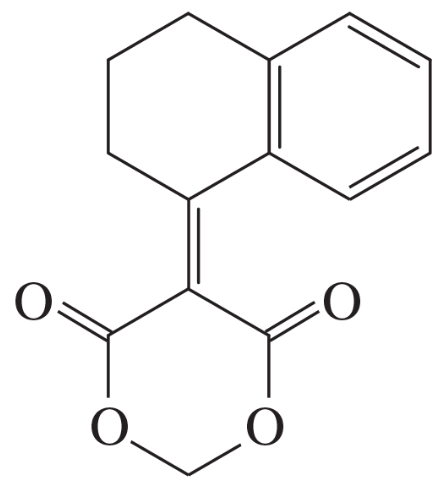
The Knoevenagel condensation is a special case of the aldol condensation in which an active methylene compound reacts with an aldehyde or ketone, in the presence of a secondary amine as a basic catalyst, to produce a new C=C. Show the starting materials that made each of these by a Knoevenagel condensation. (b)
Verified step by step guidance
1
Identify the product of the Knoevenagel condensation. The product will contain a new C=C bond formed between the alpha-carbon of the active methylene compound and the carbonyl carbon of the aldehyde or ketone.
Determine the active methylene compound. Active methylene compounds typically have two electron-withdrawing groups (e.g., -CN, -COOR, -NO2) attached to the same carbon, making the hydrogens on that carbon acidic and capable of forming a carbanion.
Determine the aldehyde or ketone used in the reaction. The carbonyl group of the aldehyde or ketone reacts with the carbanion formed from the active methylene compound to form the C=C bond.
Write the reaction mechanism. The secondary amine catalyst deprotonates the active methylene compound to form a carbanion. The carbanion then attacks the carbonyl carbon of the aldehyde or ketone, followed by elimination of water to form the final product with a C=C bond.
Combine the identified starting materials (active methylene compound and aldehyde/ketone) to show the reactants that would produce the given product through the Knoevenagel condensation.
Verified video answer for a similar problem:
This video solution was recommended by our tutors as helpful for the problem above
Play a video:
Was this helpful?
Key Concepts
Here are the essential concepts you must grasp in order to answer the question correctly.
Knoevenagel Condensation
The Knoevenagel condensation is a reaction where an active methylene compound reacts with an aldehyde or ketone in the presence of a basic catalyst, typically a secondary amine. This reaction results in the formation of a carbon-carbon double bond (C=C) and is characterized by the elimination of a small molecule, often water. It is a key reaction in organic synthesis for forming α,β-unsaturated carbonyl compounds.
Active methylene compounds are organic molecules that contain a methylene group (–CH2–) adjacent to a carbonyl group (C=O) or another electron-withdrawing group. This configuration makes the methylene hydrogen atoms particularly acidic, allowing them to be deprotonated to form carbanions, which can then participate in nucleophilic reactions, such as the Knoevenagel condensation.
Aldol condensation is a fundamental reaction in organic chemistry where aldehydes or ketones with α-hydrogens undergo a reaction to form β-hydroxy carbonyl compounds, which can further dehydrate to yield α,β-unsaturated carbonyl compounds. The Knoevenagel condensation can be viewed as a specific type of aldol condensation, where the reaction involves an active methylene compound instead of a simple aldehyde or ketone.