Give the expected products for the aldol condensations of (b) phenylacetaldehyde.
Verified step by step guidance
1
Identify the structure of phenylacetaldehyde. It consists of a benzene ring (phenyl group) attached to a CH2 group, which is further attached to an aldehyde group (-CHO). The molecular formula is C8H8O.
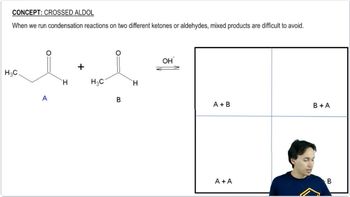
Understand the aldol condensation mechanism. It involves two steps: (1) formation of the enolate ion from the aldehyde or ketone, and (2) nucleophilic attack of the enolate on another molecule of the aldehyde or ketone, followed by dehydration to form an α,β-unsaturated carbonyl compound.
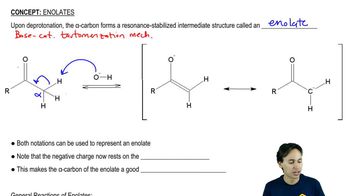
Generate the enolate ion from phenylacetaldehyde. The α-hydrogen (hydrogen on the carbon adjacent to the carbonyl group) is acidic and can be removed by a base to form the enolate ion. Represent this enolate ion as: \( \text{C}_6\text{H}_5\text{CH}=\text{CH}^- \).
Perform the nucleophilic attack. The enolate ion attacks the carbonyl carbon of another molecule of phenylacetaldehyde. This forms a β-hydroxy aldehyde intermediate. Represent this intermediate as: \( \text{C}_6\text{H}_5\text{CH}(\text{OH})\text{CH}(\text{C}_6\text{H}_5)\text{CHO} \).
Dehydrate the β-hydroxy aldehyde intermediate. Under heat or acidic/basic conditions, the intermediate loses a water molecule to form the final α,β-unsaturated carbonyl compound. Represent the product as: \( \text{C}_6\text{H}_5\text{CH}=\text{CH}(\text{C}_6\text{H}_5) \).
Verified video answer for a similar problem:
This video solution was recommended by our tutors as helpful for the problem above
Video duration:
4m
Play a video:
Was this helpful?
Key Concepts
Here are the essential concepts you must grasp in order to answer the question correctly.
Aldol Condensation
Aldol condensation is a reaction between aldehydes or ketones that contain at least one alpha-hydrogen, leading to the formation of beta-hydroxy aldehydes or ketones. This reaction involves the formation of an enolate ion from one carbonyl compound, which then attacks the carbonyl carbon of another, resulting in a beta-hydroxy carbonyl compound. Upon heating, this intermediate can undergo dehydration to yield an α,β-unsaturated carbonyl compound.
Phenylacetaldehyde, also known as 2-phenylethanal, is an aromatic aldehyde with the formula C8H8O. It features a phenyl group attached to an acetaldehyde moiety, which provides it with unique reactivity in aldol condensation reactions. The presence of the aromatic ring influences the stability of the enolate ion formed during the reaction, affecting the overall product distribution.
Enolate Ion
An enolate ion is a resonance-stabilized anion formed from a carbonyl compound when a hydrogen atom is removed from the alpha carbon. This ion plays a crucial role in aldol reactions, as it acts as a nucleophile, attacking the carbonyl carbon of another aldehyde or ketone. The stability of the enolate ion is influenced by the substituents on the carbonyl compound, which can affect the reaction pathway and the final products.