
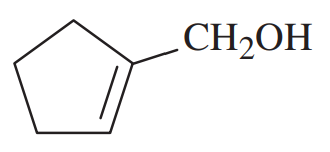


Give a systematic (IUPAC) name for each alcohol. Classify each as primary, secondary, or tertiary. (f) (g)
Verified step by step guidance
1
Step 1: Identify the longest carbon chain that contains the hydroxyl group (OH) in each structure. This will be the parent chain for naming the alcohol.
Step 2: Number the carbon atoms in the parent chain starting from the end nearest to the hydroxyl group. This ensures the lowest possible number for the OH group.
Step 3: For the first structure, observe the branching and identify any substituents attached to the main chain. The presence of a methyl group on the second carbon should be noted.
Step 4: For the second structure, recognize the cyclopentane ring and the hydroxymethyl group attached to it. The ring itself is the parent structure.
Step 5: Classify each alcohol based on the carbon atom to which the OH group is attached: primary (1°) if attached to a carbon with one other carbon, secondary (2°) if attached to a carbon with two other carbons, and tertiary (3°) if attached to a carbon with three other carbons.
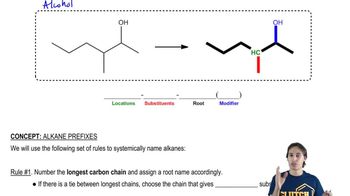
Verified video answer for a similar problem:
This video solution was recommended by our tutors as helpful for the problem above
Video duration:
14m
Play a video:
Was this helpful?
Key Concepts
Here are the essential concepts you must grasp in order to answer the question correctly.
IUPAC Nomenclature
IUPAC nomenclature is a systematic method for naming organic chemical compounds. It provides a set of rules to derive the names based on the structure of the molecule, including the longest carbon chain, functional groups, and their positions. Understanding these rules is essential for accurately naming alcohols and other organic compounds.
Alcohols are classified based on the number of carbon atoms bonded to the carbon atom that carries the hydroxyl (-OH) group. Primary alcohols have one carbon attached to the hydroxyl-bearing carbon, secondary alcohols have two, and tertiary alcohols have three. This classification affects the physical and chemical properties of the alcohols.
Functional groups are specific groups of atoms within molecules that are responsible for the characteristic chemical reactions of those molecules. In the case of alcohols, the hydroxyl group (-OH) is the functional group that defines their properties and reactivity. Recognizing functional groups is crucial for understanding the behavior of organic compounds.