Draw a condensed structure for each of the following: g. 1-bromo-1-pentyne h. 5-methyl-2-cyclohexenol
Verified step by step guidance
1
Identify the structure of 1-bromo-1-pentyne: The name indicates a five-carbon chain (pent-) with a triple bond (-yne) at the first carbon and a bromine atom (bromo-) attached to the same carbon. Start by drawing a five-carbon chain with a triple bond between C1 and C2, and attach a bromine atom to C1.
Write the condensed structure for 1-bromo-1-pentyne: Represent the triple bond as ≡ and ensure the bromine atom is explicitly shown attached to the first carbon. The condensed structure should reflect the linear arrangement of the chain.
Identify the structure of 5-methyl-2-cyclohexenol: The name indicates a cyclohexene ring (a six-membered ring with one double bond) with a hydroxyl group (-ol) on the second carbon and a methyl group (-CH₃) on the fifth carbon. Start by drawing a cyclohexene ring with a double bond between C2 and C3.
Add the substituents to the cyclohexene ring: Place the hydroxyl group (-OH) on C2 and the methyl group (-CH₃) on C5. Ensure the numbering follows IUPAC rules, with the double bond taking priority for the lowest possible numbering.
Write the condensed structure for 5-methyl-2-cyclohexenol: Represent the cyclohexene ring with the appropriate substituents in a condensed format, ensuring the double bond, hydroxyl group, and methyl group are clearly indicated.
Verified video answer for a similar problem:
This video solution was recommended by our tutors as helpful for the problem above
Video duration:
6m
Play a video:
Was this helpful?
Key Concepts
Here are the essential concepts you must grasp in order to answer the question correctly.
Condensed Structural Formula
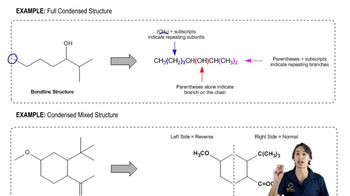
A condensed structural formula is a way of representing a chemical compound that shows the arrangement of atoms and the connectivity between them without depicting all the bonds explicitly. It typically groups atoms together to indicate how they are connected, making it easier to visualize the structure of larger molecules. For example, in a condensed formula, carbon atoms are often listed with their attached hydrogen atoms, simplifying the representation.
Nomenclature in organic chemistry refers to the systematic naming of chemical compounds based on their structure and functional groups. The International Union of Pure and Applied Chemistry (IUPAC) provides rules for naming compounds, which include identifying the longest carbon chain, numbering the chain to give substituents the lowest possible numbers, and indicating the presence of functional groups. Understanding nomenclature is essential for accurately interpreting and drawing chemical structures.
Functional groups are specific groups of atoms within molecules that are responsible for the characteristic chemical reactions of those molecules. They determine the properties and reactivity of organic compounds. For instance, in 1-bromo-1-pentyne, the alkyne functional group (triple bond) and the bromo substituent are key to understanding its reactivity, while in 5-methyl-2-cyclohexenol, the alcohol and alkene functional groups play significant roles in its chemical behavior.