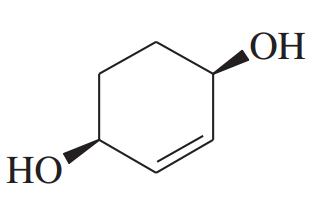
Give a systematic (IUPAC) name for each diol (a) CH3CH(OH)(CH2)4CH(OH)C(CH3)3 (b) HO-(CH2)8-OH (c)
Verified step by step guidance
1
Step 1: Analyze the structure of compound (a). Identify the longest carbon chain containing both hydroxyl groups. The parent chain has 8 carbons, and the hydroxyl groups are located on carbons 2 and 7. Assign the lowest possible locants to the hydroxyl groups.
Step 2: For compound (a), name the substituents. There is a tert-butyl group attached to carbon 7. Combine the substituent name with the parent chain name, ensuring proper placement of locants.
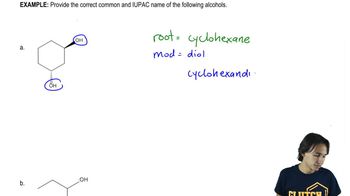
Step 3: Analyze compound (b). This is a straight-chain diol with 8 carbons. The hydroxyl groups are located at both ends of the chain (positions 1 and 8). Use the prefix 'octane' for the parent chain and add 'diol' to indicate two hydroxyl groups.
Step 4: For compound (c) (image provided), identify the parent chain as cyclohexene. The hydroxyl groups are located on carbons 1 and 2, and both are in cis configuration. Use the prefix 'cyclohexene' and add 'diol' to indicate two hydroxyl groups. Specify the stereochemistry as 'cis'.
Step 5: Combine all elements for each compound systematically. Ensure proper IUPAC naming conventions are followed, including locants, substituents, and stereochemistry where applicable.
Verified video answer for a similar problem:
This video solution was recommended by our tutors as helpful for the problem above
Video duration:
10m
Play a video:
Was this helpful?
Key Concepts
Here are the essential concepts you must grasp in order to answer the question correctly.
IUPAC Nomenclature
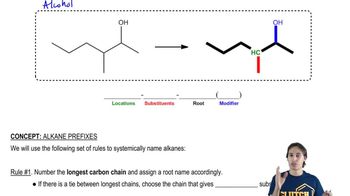
IUPAC nomenclature is a systematic method for naming organic chemical compounds. It provides rules for naming based on the structure of the molecule, including the longest carbon chain, functional groups, and their positions. Understanding these rules is essential for accurately naming compounds, especially those with multiple functional groups like diols.
Diols, also known as glycols, are organic compounds containing two hydroxyl (-OH) groups. Their properties and reactivity can differ significantly from those of alcohols with a single hydroxyl group. Recognizing the structure and functional groups of diols is crucial for determining their IUPAC names and understanding their chemical behavior.
Structural isomerism occurs when compounds have the same molecular formula but different structural arrangements of atoms. This concept is important in organic chemistry as it affects the physical and chemical properties of compounds. Identifying isomers is key when naming compounds, particularly for diols that may have multiple structural forms.