
Textbook Question
Dimethylamine, (CH3)2NH, has a molecular weight of 45 and a boiling point of 7.4 °C. Trimethylamine, (CH3)3N, has a higher molecular weight (59) but a lower boiling point (3.5 °C). Explain this apparent discrepancy.
1425
views


 Verified step by step guidance
 03:43
03:43
 01:49
01:49 02:36
02:36Dimethylamine, (CH3)2NH, has a molecular weight of 45 and a boiling point of 7.4 °C. Trimethylamine, (CH3)3N, has a higher molecular weight (59) but a lower boiling point (3.5 °C). Explain this apparent discrepancy.
For each molecular formula, draw all the possible constitutional isomers of alcohols with that formula. Give the IUPAC name for each alcohol.
(c) C3H6O
For each molecular formula, draw all the possible constitutional isomers of alcohols with that formula. Give the IUPAC name for each alcohol.
(d) C3H4O
Predict which member of each pair will be more soluble in water. Explain the reasons for your answers.
(a) hexan-1-ol or cyclohexanol
(b) heptan-1-ol or 4-methylphenol
(c) 3-ethylhexan-3-ol or octan-2-ol
(d) hexan-2-ol or cyclooctane-1,4-diol
(e)
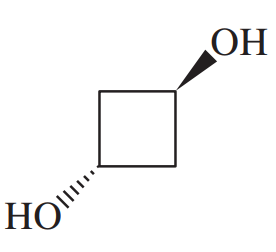
Give a systematic (IUPAC) name for each diol
(a) CH3CH(OH)(CH2)4CH(OH)C(CH3)3
(b) HO-(CH2)8-OH
(c)
Predict which member of each pair will be more acidic. Explain your answers.
c. 2-chloroethanol or 2,2-dichloroethanol