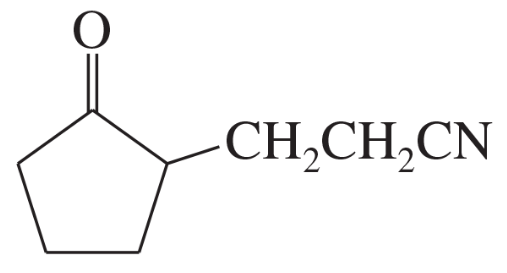
Show how the following products might be synthesized from suitable Michael donors and acceptors. (c)
Verified step by step guidance
1
Step 1: Identify the product structure. The given product is a 1,5-diketone, which is characteristic of a Michael addition reaction. This suggests that the synthesis involves a conjugate addition of a nucleophile (Michael donor) to an α,β-unsaturated carbonyl compound (Michael acceptor).
Step 2: Determine the Michael donor. A suitable Michael donor for this reaction would be a compound with an active methylene group, such as diethyl malonate or ethyl acetoacetate. These compounds have acidic hydrogens that can be deprotonated to form a nucleophilic enolate.
Step 3: Determine the Michael acceptor. The Michael acceptor should be an α,β-unsaturated carbonyl compound, such as methyl vinyl ketone or acrylonitrile. These compounds have an electrophilic β-carbon due to conjugation with the carbonyl group.
Step 4: Outline the reaction mechanism. The Michael donor is first deprotonated using a base (e.g., NaOEt or NaOH) to form the enolate ion. The enolate then attacks the β-carbon of the Michael acceptor in a conjugate addition reaction, forming a new C-C bond.
Step 5: Perform the final steps to obtain the product. After the conjugate addition, the intermediate undergoes protonation to stabilize the product. If necessary, additional steps such as hydrolysis or decarboxylation may be performed to achieve the final 1,5-diketone structure.
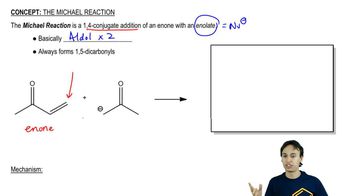
Verified video answer for a similar problem:
This video solution was recommended by our tutors as helpful for the problem above
Video duration:
6m
Play a video:
Was this helpful?
Key Concepts
Here are the essential concepts you must grasp in order to answer the question correctly.
Michael Addition
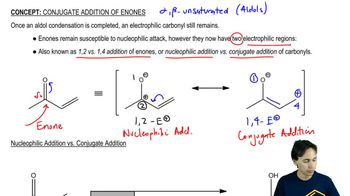
Michael addition is a nucleophilic addition reaction where a nucleophile adds to an α,β-unsaturated carbonyl compound. In this reaction, a Michael donor, typically a compound with a nucleophilic site, attacks the electrophilic carbon of the double bond in the acceptor, leading to the formation of a new carbon-carbon bond. This reaction is fundamental in organic synthesis for constructing complex molecules.
Michael donors are typically compounds with nucleophilic sites, such as enolates or other electron-rich species, while Michael acceptors are usually α,β-unsaturated carbonyl compounds that can accept the nucleophile. The choice of suitable donors and acceptors is crucial for the success of the Michael addition, as they determine the regioselectivity and stereochemistry of the resulting product.
Carbonyl compounds, characterized by the presence of a carbon-oxygen double bond (C=O), play a significant role in organic reactions, including Michael additions. The reactivity of carbonyls is influenced by their electrophilic nature, which allows them to participate in various nucleophilic addition reactions. Understanding the properties and reactivity of carbonyl groups is essential for predicting the outcomes of synthetic pathways involving these compounds.