
Textbook Question
Indicate how each of the following compounds can be synthesized from the given starting material and any other necessary reagents:
b.
1201
views

 Verified step by step guidance
 05:53
05:53
 1:00 05:53
Indicate how each of the following compounds can be synthesized from the given starting material and any other necessary reagents:
b.
There are other condensation reactions similar to the aldol and Claisen condensations:
c. The Knoevenagel condensation is the condensation of an aldehyde or a ketone that has no a-hydrogens and a compound such as diethyl malonate that has an a-carbon flanked by two electron-withdrawing groups. Draw the product obtained from the following Knoevenagel condensation:
There are other condensation reactions similar to the aldol and Claisen condensations:
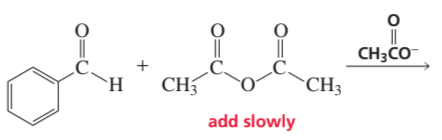
a. The Perkin condensation is the condensation of an aromatic aldehyde and acetic anhydride. Draw the product obtained from the following Perkin condensation:
A β-ɣ-unsaturated carbonyl compound rearranges to a more stable conjugated ⍺,β-unsaturated compound in the presence of either acid or base. b. Propose a mechanism for the acid-catalyzed rearrangement.
Show how the following compound can be synthesized from the given starting material. (Hint: Start with an acetoacetic ester.)
What product is obtained when the product of a Knoevenagel condensation is heated in an aqueous acidic solution?