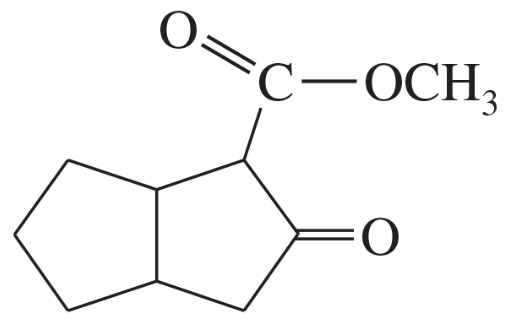
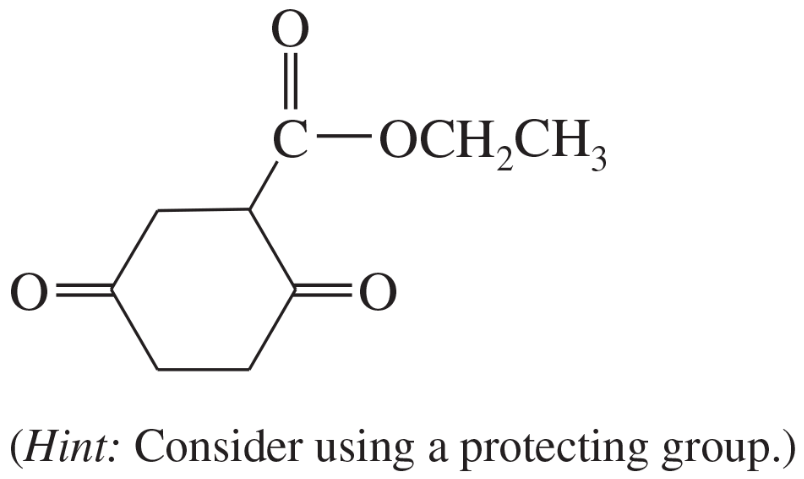
Some (but not all) of the following keto esters can be formed by Dieckmann condensations. Determine which ones are possible, and draw the starting diesters. (c) (d)
Verified step by step guidance
1
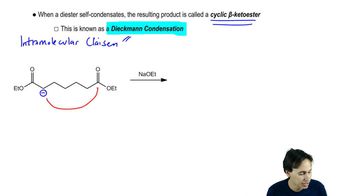
Step 1: Understand the Dieckmann condensation reaction. It is an intramolecular reaction where a diester undergoes base-catalyzed cyclization to form a β-keto ester. This reaction requires the diester to have two ester groups separated by a suitable number of carbons to form a stable ring.
Step 2: Analyze structure (A). The product shown is a bicyclic β-keto ester. To form this structure via Dieckmann condensation, the starting diester must have two ester groups positioned such that cyclization forms the bicyclic ring system. Verify if the ester groups are appropriately spaced for cyclization.
Step 3: Analyze structure (B). The product shown is a monocyclic β-keto ester. To form this structure via Dieckmann condensation, the starting diester must have two ester groups positioned such that cyclization forms the six-membered ring. Check if the ester groups are appropriately spaced for cyclization.
Step 4: Draw the starting diesters for both (A) and (B). For (A), the diester should have ester groups on carbons that allow formation of the bicyclic system. For (B), the diester should have ester groups on carbons that allow formation of the six-membered ring.
Step 5: Confirm the feasibility of the Dieckmann condensation for each structure. Ensure that the reaction conditions (base and solvent) would favor cyclization and that the resulting rings are stable (e.g., five- or six-membered rings are preferred).
Verified video answer for a similar problem:
This video solution was recommended by our tutors as helpful for the problem above
Video duration:
2m
Play a video:
Was this helpful?
Key Concepts
Here are the essential concepts you must grasp in order to answer the question correctly.
Dieckmann Condensation
Dieckmann condensation is a type of intramolecular Claisen condensation that occurs between two ester groups in the presence of a strong base. This reaction typically leads to the formation of a β-keto ester or a cyclic compound. Understanding the conditions and mechanisms of this reaction is crucial for determining which keto esters can be synthesized from given diesters.
Keto esters are organic compounds that contain both a ketone and an ester functional group. They are characterized by the presence of a carbonyl group (C=O) adjacent to an ester group (RCOOR'). The structure and reactivity of keto esters are important in organic synthesis, particularly in reactions like Dieckmann condensation, where they can serve as intermediates or products.
Starting diesters are the initial compounds used in the Dieckmann condensation process. They typically contain two ester functional groups that can react under basic conditions to form a cyclic product. Identifying the correct starting diesters is essential for predicting the possible keto esters that can be formed, as the structure and arrangement of these diesters influence the outcome of the reaction.