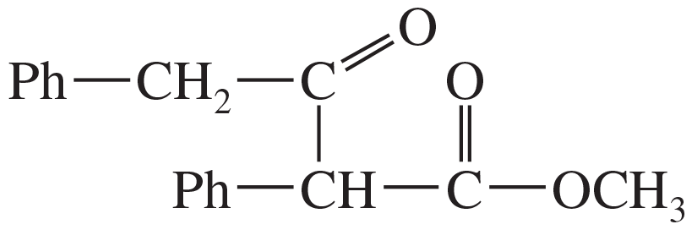
Show what esters would undergo Claisen condensation to give the following β-keto esters. (b)
Verified step by step guidance
1
Step 1: Identify the β-keto ester structure in the given compound. The β-keto ester contains a ketone group (C=O) at the β-position relative to the ester group (COOR). In this case, the compound has a phenyl group (Ph) attached to the α-carbon and another phenyl group attached to the β-carbon.
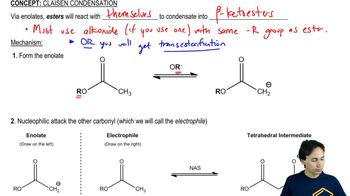
Step 2: Recall the Claisen condensation mechanism. This reaction involves two ester molecules reacting in the presence of a strong base (such as alkoxide) to form a β-keto ester. One ester acts as the nucleophile, and the other acts as the electrophile.
Step 3: Analyze the structure of the product to deduce the starting esters. The product has two distinct ester groups: one with a methyl group (OCH₃) and the other with a phenyl group (Ph-CH₂). This suggests that the starting esters are methyl benzoate (Ph-CH₂-COOCH₃) and methyl phenylacetate (Ph-CH₂-COOCH₃).
Step 4: Write the reaction setup. In the Claisen condensation, the enolate ion formed from one ester (via deprotonation at the α-carbon) attacks the carbonyl carbon of the second ester. This leads to the formation of the β-keto ester after elimination of the alkoxide group.
Step 5: Verify the compatibility of the starting esters with the product. Ensure that the phenyl groups and methyl groups in the product match the substituents in the starting esters. The reaction conditions typically involve a base like sodium ethoxide (NaOEt) in ethanol (EtOH) to facilitate the condensation.
Verified video answer for a similar problem:
This video solution was recommended by our tutors as helpful for the problem above
Video duration:
3m
Play a video:
Was this helpful?
Key Concepts
Here are the essential concepts you must grasp in order to answer the question correctly.
Claisen Condensation
Claisen condensation is a reaction between two esters or an ester and a carbonyl compound in the presence of a strong base, leading to the formation of a β-keto ester or a β-diketone. This reaction involves the nucleophilic attack of an enolate ion on the carbonyl carbon of another ester, followed by the elimination of an alcohol. Understanding this mechanism is crucial for predicting the products formed in the reaction.
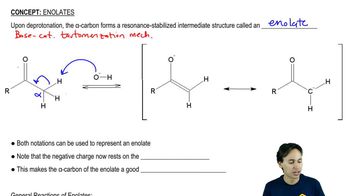
Enolate ions are formed when a base abstracts a proton from the α-carbon of an ester or carbonyl compound, resulting in a resonance-stabilized anion. This enolate ion acts as a nucleophile in Claisen condensation, attacking the carbonyl carbon of another ester. Recognizing how to generate and utilize enolate ions is essential for successfully carrying out and understanding Claisen reactions.
β-Keto esters are compounds that contain both a ketone and an ester functional group, with the carbonyl of the ketone located at the β-position relative to the ester group. They are significant intermediates in organic synthesis and can be formed through Claisen condensation. Identifying the structure and properties of β-keto esters is important for understanding the outcomes of the Claisen reaction and their subsequent reactivity.