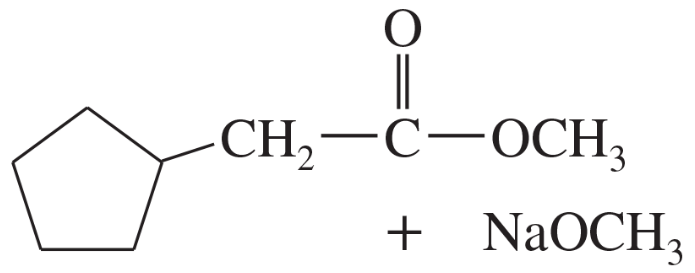
Predict the products of self-condensation of the following esters. (c)
Verified step by step guidance
1
Step 1: Recognize that the reaction involves the self-condensation of esters under basic conditions. The base used here is sodium methoxide (NaOCH₃), which will deprotonate the alpha-hydrogen of the ester to form an enolate ion.
Step 2: Identify the alpha-hydrogen in the ester structure. The alpha-hydrogen is located on the carbon adjacent to the carbonyl group (C=O). This hydrogen is acidic and can be removed by the base to form the enolate ion.
Step 3: The enolate ion acts as a nucleophile and attacks the carbonyl carbon of another ester molecule. This nucleophilic attack leads to the formation of a new carbon-carbon bond.
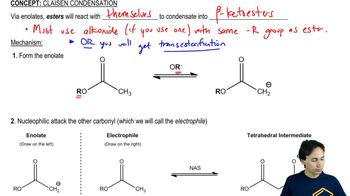
Step 4: After the nucleophilic attack, the intermediate undergoes proton transfer and elimination of the methoxide ion (CH₃O⁻), resulting in the formation of a β-keto ester. This is the typical product of ester self-condensation.
Step 5: Write the final product structure, which is a β-keto ester. The β-keto ester will have a ketone group (C=O) and an ester group (COOCH₃) separated by one carbon atom. Ensure the cyclic structure of the original ester is preserved in the product.
Verified video answer for a similar problem:
This video solution was recommended by our tutors as helpful for the problem above
Video duration:
4m
Play a video:
Was this helpful?
Key Concepts
Here are the essential concepts you must grasp in order to answer the question correctly.
Claisen Condensation
Claisen condensation is a reaction between two esters or an ester and a carbonyl compound in the presence of a strong base, typically an alkoxide. This reaction results in the formation of a β-keto ester or a β-diketone. The mechanism involves the deprotonation of an ester to form an enolate ion, which then attacks the carbonyl carbon of another ester, leading to the formation of a new carbon-carbon bond.
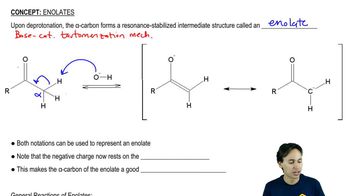
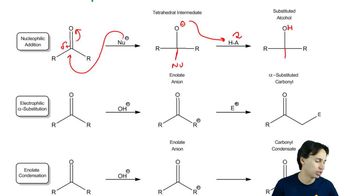
An enolate ion is a resonance-stabilized anion formed by the deprotonation of a carbonyl compound, such as an ester or ketone. This ion is crucial in nucleophilic addition reactions, as it acts as a nucleophile that can attack electrophiles, such as carbonyl carbons. The stability of the enolate ion is influenced by the substituents on the carbonyl compound, which can affect the reaction's regioselectivity and reactivity.
Self-condensation of esters refers to the reaction where a single type of ester undergoes Claisen condensation with itself, leading to the formation of a β-keto ester or a β-diketone. This process requires a strong base to generate the enolate ion from the ester, which then attacks another molecule of the same ester. The reaction typically results in the formation of a new carbon-carbon bond and the release of an alcohol as a byproduct.