

Show how you would convert a. oct-3-yne to cis-oct-3-ene. b. pent-2-yne to trans-pent-2-ene.
Verified step by step guidance
1
Step 1: Recognize that the conversion of an alkyne to an alkene involves a reduction reaction. The type of reduction (cis or trans) depends on the reagents used.
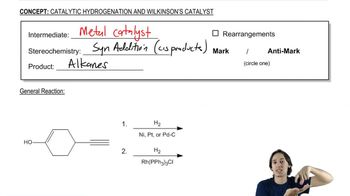
Step 2: For part (a), to convert oct-3-yne to cis-oct-3-ene, use Lindlar's catalyst. Lindlar's catalyst is a poisoned palladium catalyst that selectively reduces alkynes to cis-alkenes by adding hydrogen (H₂) in a syn-addition manner.
Step 3: Write the reaction for part (a): (cis configuration).
Step 4: For part (b), to convert pent-2-yne to trans-pent-2-ene, use sodium (Na) in liquid ammonia (NH₃). This is a dissolving metal reduction that selectively reduces alkynes to trans-alkenes by adding hydrogen (H₂) in an anti-addition manner.
Step 5: Write the reaction for part (b): (trans configuration).
Verified video answer for a similar problem:
This video solution was recommended by our tutors as helpful for the problem above
Video duration:
3m
Play a video:
Was this helpful?
Key Concepts
Here are the essential concepts you must grasp in order to answer the question correctly.
Alkyne to Alkene Conversion
The conversion of alkynes to alkenes typically involves a process called hydrogenation, where hydrogen gas is added to the alkyne in the presence of a catalyst. This reaction reduces the triple bond of the alkyne to a double bond, forming an alkene. The stereochemistry of the resulting alkene can be controlled by the choice of catalyst and reaction conditions.
Stereochemistry refers to the spatial arrangement of atoms in molecules and is crucial for understanding the properties of alkenes. In the case of cis and trans isomers, the terms describe the relative positioning of substituents around the double bond. Cis isomers have substituents on the same side, while trans isomers have them on opposite sides, affecting the physical properties and reactivity of the compounds.
Selective hydrogenation is a technique used to convert alkynes to specific alkenes while controlling the stereochemistry. Common reagents include Lindlar's catalyst, which allows for the formation of cis alkenes, and sodium in liquid ammonia, which can yield trans alkenes. Understanding the choice of reagents is essential for achieving the desired product in organic synthesis.