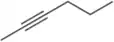
For the alkynes shows here, show the product(s) expected to form when treated under the following conditions: (i) H2 , Pd/C; If you expect two products, show both. (c)
Verified step by step guidance
1
Step 1: Identify the alkyne structure in the given problem. Alkynes are hydrocarbons containing a triple bond between two carbon atoms. The reactivity of the alkyne will depend on whether it is terminal (triple bond at the end of the chain) or internal (triple bond within the chain).
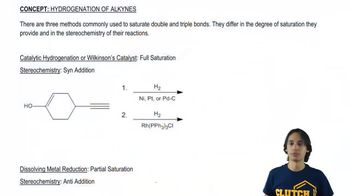
Step 2: Understand the reaction conditions. The problem specifies treatment with H₂ and Pd/C. This is a catalytic hydrogenation reaction, where molecular hydrogen (H₂) is used in the presence of a palladium catalyst supported on carbon (Pd/C). This reaction typically reduces the alkyne completely to an alkane.
Step 3: Predict the mechanism of the reaction. In the presence of Pd/C, the alkyne undergoes successive addition of hydrogen across the triple bond. First, the triple bond is reduced to a double bond (alkene), and then the double bond is further reduced to a single bond (alkane).
Step 4: Determine the product(s). If the alkyne is symmetrical, the reduction will yield a single alkane product. If the alkyne is asymmetrical, the reduction will still yield a single alkane product because the addition of hydrogen is not regioselective under these conditions.
Step 5: If two products are expected, consider stereochemistry or structural variations. However, in this case, catalytic hydrogenation with Pd/C does not typically lead to stereoisomeric products, as the reaction proceeds through a syn-addition mechanism, and the final product is a fully saturated alkane.
Verified video answer for a similar problem:
This video solution was recommended by our tutors as helpful for the problem above
Video duration:
2m
Play a video:
Was this helpful?
Key Concepts
Here are the essential concepts you must grasp in order to answer the question correctly.
Alkynes
Alkynes are hydrocarbons that contain at least one carbon-carbon triple bond. They are unsaturated compounds and can undergo various reactions, including hydrogenation, where the triple bond is converted into a double or single bond. Understanding the structure and reactivity of alkynes is crucial for predicting the products of their reactions.
Hydrogenation is a chemical reaction that involves the addition of hydrogen (H₂) to an unsaturated compound, such as an alkyne or alkene. In the presence of a catalyst like palladium on carbon (Pd/C), alkynes can be converted to alkenes or alkanes. The extent of hydrogenation depends on the reaction conditions and the number of hydrogen molecules added.
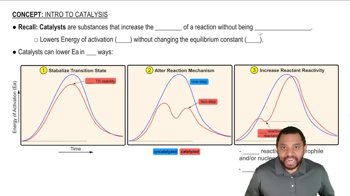
Catalysts are substances that increase the rate of a chemical reaction without being consumed in the process. In the context of hydrogenation, palladium on carbon (Pd/C) serves as a catalyst that facilitates the addition of hydrogen to alkynes. Understanding the role of catalysts is essential for predicting reaction pathways and the formation of products.