Predict the products of the following Claisen condensations. (a) (b)
Verified step by step guidance
1
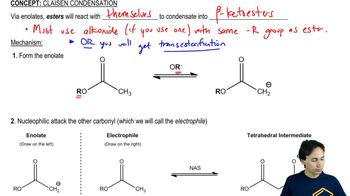
Step 1: Identify the reaction type. The Claisen condensation involves the reaction of an ester with a base to form a β-keto ester. The base used here is methoxide (−OCH₃) in methanol (CH₃OH).
Step 2: Analyze the structure of the starting ester. In part (a), the ester is methyl isobutyrate (CH₃)₂CHCH₂COOCH₃. In part (b), the ester is methyl cyclohexylacetate, which contains a cyclohexane ring and a methyl group attached to the α-carbon.
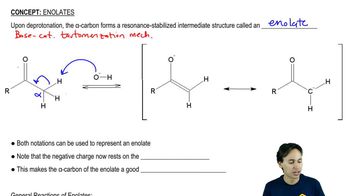
Step 3: Deprotonation of the α-hydrogen. The methoxide base will abstract the acidic α-hydrogen from the ester, forming an enolate ion. This enolate ion is stabilized by resonance between the α-carbon and the carbonyl group.
Step 4: Nucleophilic attack of the enolate. The enolate ion will attack the carbonyl carbon of another ester molecule, leading to the formation of a new C-C bond. This step results in the formation of a tetrahedral intermediate.
Step 5: Elimination of the leaving group. The tetrahedral intermediate will collapse, expelling the methoxide ion (−OCH₃) as a leaving group. This results in the formation of a β-keto ester as the final product for both reactions.
Verified video answer for a similar problem:
This video solution was recommended by our tutors as helpful for the problem above
Video duration:
2m
Play a video:
Was this helpful?
Key Concepts
Here are the essential concepts you must grasp in order to answer the question correctly.
Claisen Condensation
Claisen condensation is a reaction between two esters or an ester and a carbonyl compound in the presence of a strong base, typically sodium ethoxide. This reaction results in the formation of a β-keto ester or a β-diketone. Understanding the mechanism involves recognizing the nucleophilic attack of the enolate ion on the carbonyl carbon, followed by the elimination of an alcohol.
Enolate ions are formed when a base abstracts a proton from the alpha carbon of a carbonyl compound, resulting in a resonance-stabilized anion. This species is crucial in Claisen condensation as it acts as a nucleophile, attacking another carbonyl compound. The stability of the enolate ion influences the reaction's efficiency and product distribution.
Predicting the products of a Claisen condensation requires understanding the structure of the starting materials and the regioselectivity of the reaction. The outcome depends on the nature of the carbonyl compounds involved, as well as any substituents that may influence sterics and electronics. Analyzing the reaction mechanism helps in determining the final products formed after the condensation and subsequent elimination of alcohol.