Predict the products of the reactions of the following compounds with: 1. chromic acid or excess sodium hypochlorite with acetic acid. 2. PCC or NaOCl (1 equivalent) with TEMPO. a. cyclohexanol b. 1-methylcyclohexanol c. cyclopentylmethanol
Verified step by step guidance
1
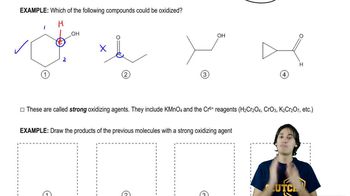
Step 1: Understand the role of the oxidizing agents. Chromic acid (H2CrO4) and excess sodium hypochlorite (NaOCl) with acetic acid are strong oxidizing agents that can oxidize primary alcohols to carboxylic acids and secondary alcohols to ketones. PCC (pyridinium chlorochromate) and NaOCl with TEMPO are milder oxidizing agents that typically oxidize primary alcohols to aldehydes and secondary alcohols to ketones.
Step 2: Analyze the structure of cyclohexanol (a). Cyclohexanol is a secondary alcohol. When treated with chromic acid or excess NaOCl with acetic acid, it will be oxidized to cyclohexanone, a ketone. Similarly, PCC or NaOCl with TEMPO will also oxidize cyclohexanol to cyclohexanone.
Step 3: Examine 1-methylcyclohexanol (b). This compound is a secondary alcohol due to the hydroxyl group (-OH) attached to a carbon that is bonded to two other carbons. Both strong oxidizing agents (chromic acid or excess NaOCl with acetic acid) and mild oxidizing agents (PCC or NaOCl with TEMPO) will oxidize 1-methylcyclohexanol to 1-methylcyclohexanone, a ketone.
Step 4: Consider cyclopentylmethanol (c). Cyclopentylmethanol is a primary alcohol because the hydroxyl group is attached to a carbon bonded to only one other carbon. Strong oxidizing agents (chromic acid or excess NaOCl with acetic acid) will oxidize cyclopentylmethanol to cyclopentylcarboxylic acid, a carboxylic acid. Mild oxidizing agents (PCC or NaOCl with TEMPO) will oxidize cyclopentylmethanol to cyclopentylcarbaldehyde, an aldehyde.
Step 5: Summarize the expected products. For cyclohexanol (a), the product is cyclohexanone regardless of the oxidizing agent. For 1-methylcyclohexanol (b), the product is 1-methylcyclohexanone regardless of the oxidizing agent. For cyclopentylmethanol (c), the product is cyclopentylcarboxylic acid with strong oxidizing agents and cyclopentylcarbaldehyde with mild oxidizing agents.
Verified video answer for a similar problem:
This video solution was recommended by our tutors as helpful for the problem above
Video duration:
8m
Play a video:
Was this helpful?
Key Concepts
Here are the essential concepts you must grasp in order to answer the question correctly.
Oxidation Reactions
Oxidation reactions involve the loss of electrons or an increase in oxidation state of a molecule. In organic chemistry, this often pertains to the conversion of alcohols to carbonyl compounds (aldehydes or ketones) or carboxylic acids. Understanding the specific oxidizing agents, such as chromic acid or PCC, is crucial as they dictate the extent of oxidation and the resulting products.
Alcohols can undergo various reactions based on their structure and the reagents used. Primary, secondary, and tertiary alcohols react differently with oxidizing agents. For instance, primary alcohols can be oxidized to aldehydes or carboxylic acids, while secondary alcohols typically yield ketones. Recognizing the type of alcohol is essential for predicting the products of the reactions.
Different oxidizing agents exhibit varying selectivity in their reactions with alcohols. For example, PCC is a mild oxidant that selectively oxidizes primary alcohols to aldehydes without further oxidation to carboxylic acids, while chromic acid is a stronger oxidant that can fully oxidize primary alcohols to carboxylic acids. Understanding these nuances helps in accurately predicting the products formed in the reactions.