
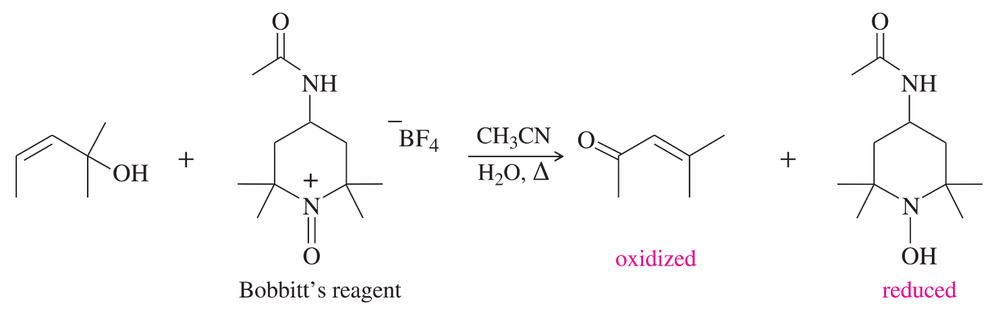
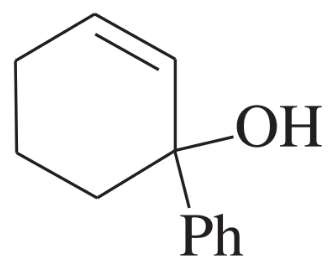
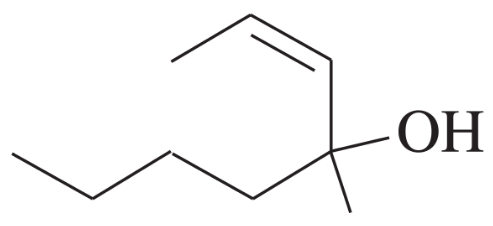
Under normal circumstances, tertiary alcohols are not oxidized. However, when the tertiary alcohol is allylic, it can undergo a migration of the double bond (called an allylic shift) and subsequent oxidation of the alcohol. A particularly effective reagent for this reaction is Bobbitt's reagent, similar to TEMPO used in many oxidations. (M. Shibuya etal., J. Org. Chem., 2008, 73, 4750.) Show the expected product when each of these 3° allylic alcohols is oxidized by Bobbitt's reagent. (a) (b)
Verified step by step guidance
1
Step 1: Identify the structure of the tertiary allylic alcohols in the given problem. In (a), the alcohol is attached to a cyclohexene ring with a phenyl group. In (b), the alcohol is attached to a chain containing a double bond in an allylic position.
Step 2: Understand the mechanism of oxidation using Bobbitt's reagent. Bobbitt's reagent facilitates the oxidation of allylic alcohols by first enabling an allylic shift of the double bond, followed by the conversion of the alcohol group into a carbonyl group.
Step 3: For compound (a), the allylic shift will move the double bond within the cyclohexene ring, and the hydroxyl group will be oxidized to a ketone. The phenyl group remains unaffected during this reaction.
Step 4: For compound (b), the allylic shift will reposition the double bond along the chain, and the hydroxyl group will be oxidized to a ketone. The rest of the chain structure remains intact.
Step 5: Draw the expected products for both (a) and (b). For (a), the product will be a cyclohexenone with a phenyl group attached. For (b), the product will be a linear chain with a ketone group and a repositioned double bond.
Verified video answer for a similar problem:
This video solution was recommended by our tutors as helpful for the problem above
Video duration:
4m
Play a video:
Was this helpful?
Key Concepts
Here are the essential concepts you must grasp in order to answer the question correctly.
Tertiary Alcohols
Tertiary alcohols are organic compounds where the hydroxyl (-OH) group is attached to a carbon atom that is connected to three other carbon atoms. This structure makes them relatively stable and less reactive towards oxidation under normal conditions. However, when they are allylic, they can undergo unique reactions, such as allylic shifts, which allow for oxidation.
An allylic shift is a rearrangement reaction where a double bond migrates to a neighboring carbon atom adjacent to a functional group, such as an alcohol. This process is significant in the oxidation of allylic alcohols, as it allows the formation of more reactive intermediates that can be further oxidized, leading to the formation of carbonyl compounds.
Bobbitt's reagent is a specialized oxidizing agent used in organic chemistry, particularly effective for oxidizing allylic alcohols. It facilitates the conversion of alcohols to carbonyl compounds through a mechanism that often involves the formation of a cyclic intermediate. This reagent is similar to TEMPO, another well-known oxidant, and is used to achieve selective oxidation under mild conditions.