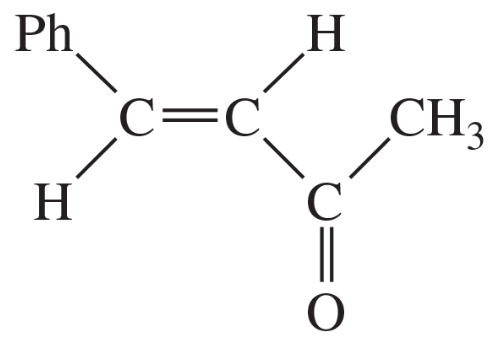
Predict the major products of the following crossed Claisen condensations. (c)
Verified step by step guidance
1
Step 1: Identify the reactants involved in the crossed Claisen condensation. In this case, the reactants are a ketone (CH3COCH2CH2CH2CH3) and an ester (CH3COOCH2CH3). The base used is sodium ethoxide (NaOCH2CH3).
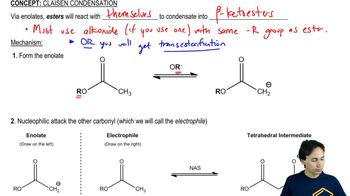
Step 2: Recognize the mechanism of the Claisen condensation. The base deprotonates the alpha-hydrogen of the ketone, forming an enolate ion. This enolate ion is nucleophilic and will attack the electrophilic carbonyl carbon of the ester.
Step 3: Write the nucleophilic attack step. The enolate ion formed from the ketone attacks the carbonyl carbon of the ester, leading to the formation of a tetrahedral intermediate.
Step 4: Describe the elimination step. The tetrahedral intermediate collapses, expelling the ethoxide ion (CH3CH2O−) as a leaving group, and forming a β-keto ester product.
Step 5: Predict the major product. The major product of this reaction will be a β-keto ester, specifically CH3COCH2CH2CH2CH2COOCH2CH3, as the ketone enolate reacts with the ester to form the condensation product.
Verified video answer for a similar problem:
This video solution was recommended by our tutors as helpful for the problem above
Video duration:
8m
Play a video:
Was this helpful?
Key Concepts
Here are the essential concepts you must grasp in order to answer the question correctly.
Claisen Condensation
Claisen condensation is a reaction between two esters or an ester and a carbonyl compound in the presence of a strong base, leading to the formation of a β-keto ester or a β-diketone. This reaction involves the nucleophilic attack of an enolate ion on the carbonyl carbon, followed by the elimination of an alcohol. Understanding this mechanism is crucial for predicting the products of crossed Claisen condensations.
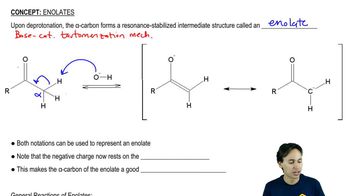
Enolate ions are formed when a strong base abstracts a proton from the α-carbon of a carbonyl compound, resulting in a resonance-stabilized anion. This species is a key intermediate in Claisen condensation, as it acts as a nucleophile that attacks another carbonyl compound. Recognizing how to generate and utilize enolate ions is essential for predicting the outcomes of reactions involving carbonyl compounds.
Crossed Claisen condensation refers to the reaction where two different carbonyl compounds react in the presence of a base, leading to the formation of a product that may not be straightforward to predict. The selectivity of the reaction depends on the reactivity of the carbonyl compounds involved and the stability of the resulting enolate ions. Understanding the factors influencing product formation is vital for accurately predicting the major products in such reactions.