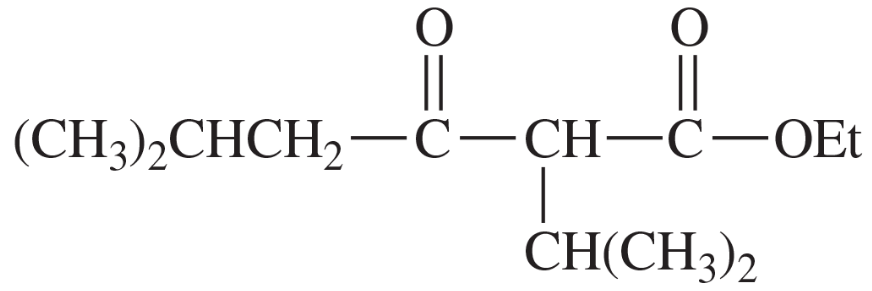
Show what esters would undergo Claisen condensation to give the following β-keto esters. (c)
Verified step by step guidance
1
Identify the β-keto ester product structure. A β-keto ester contains a ketone group (C=O) at the β-position relative to the ester group (-COOR). Analyze the given β-keto ester to determine the two fragments that could combine during the Claisen condensation.
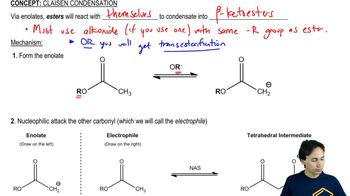
Recall the mechanism of the Claisen condensation. It involves the reaction of two ester molecules in the presence of a strong base (commonly an alkoxide base) to form a β-keto ester. One ester acts as the nucleophile, and the other acts as the electrophile.
Determine the nucleophilic ester. The nucleophile is the ester that loses an α-hydrogen to form an enolate ion. Identify the ester fragment in the β-keto ester that could form the enolate ion by deprotonation at the α-carbon.
Determine the electrophilic ester. The electrophile is the ester that undergoes nucleophilic acyl substitution. Identify the ester fragment in the β-keto ester that could act as the electrophile during the condensation reaction.
Combine the nucleophilic and electrophilic esters. Write the structures of the two esters that would react in the Claisen condensation to form the given β-keto ester. Ensure that the α-carbon of the nucleophilic ester aligns with the carbonyl carbon of the electrophilic ester in the product.
Verified video answer for a similar problem:
This video solution was recommended by our tutors as helpful for the problem above
Play a video:
Was this helpful?
Key Concepts
Here are the essential concepts you must grasp in order to answer the question correctly.
Claisen Condensation
Claisen condensation is a reaction between two esters or an ester and a carbonyl compound in the presence of a strong base, typically sodium ethoxide. This reaction results in the formation of a β-keto ester or a β-diketone. The mechanism involves the deprotonation of an alpha hydrogen, leading to the formation of an enolate ion, which then attacks the carbonyl carbon of another ester.
β-Keto esters are organic compounds that contain both a ketone and an ester functional group, with the ketone located at the beta position relative to the ester. They are important intermediates in organic synthesis and can undergo further reactions, such as decarboxylation or hydrolysis, to yield various useful products. Understanding their structure helps in predicting their reactivity in Claisen condensation.
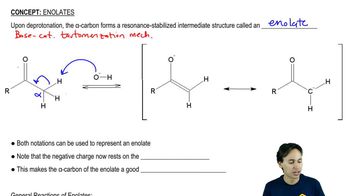
An enolate ion is a resonance-stabilized anion formed by the deprotonation of an alpha carbon adjacent to a carbonyl group. This species is crucial in nucleophilic addition reactions, such as Claisen condensation, where it acts as a nucleophile. The stability of the enolate ion influences the reaction pathway and the products formed, making it essential to understand in the context of ester reactions.