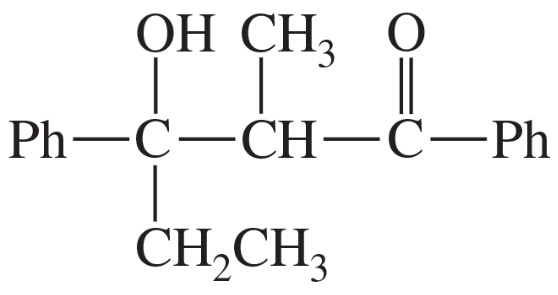
Predict the major products of the following crossed Claisen condensations. (b)
Verified step by step guidance
1
Step 1: Understand the Claisen condensation reaction. A Claisen condensation involves the reaction between two esters or one ester and a ketone in the presence of a strong base, typically an alkoxide, to form a β-keto ester or β-diketone. Crossed Claisen condensations occur between two different esters or an ester and a ketone.
Step 2: Identify the reactants in the crossed Claisen condensation. Determine which compounds are involved in the reaction and note their functional groups (e.g., ester or ketone). This will help predict the nucleophile and electrophile in the reaction.
Step 3: Determine the nucleophile. The nucleophile is typically the enolate ion formed by deprotonation of the α-hydrogen of the ester or ketone. Write the enolate structure using MathML: .
Step 4: Determine the electrophile. The electrophile is the carbonyl carbon of the ester or ketone that will undergo nucleophilic attack. Write the electrophile structure using MathML: .
Step 5: Predict the major product. After the nucleophilic attack, the intermediate undergoes elimination of the leaving group (typically an alkoxide ion), resulting in the formation of a β-keto ester or β-diketone. Write the general product structure using MathML: .
Verified video answer for a similar problem:
This video solution was recommended by our tutors as helpful for the problem above
Play a video:
Was this helpful?
Key Concepts
Here are the essential concepts you must grasp in order to answer the question correctly.
Claisen Condensation
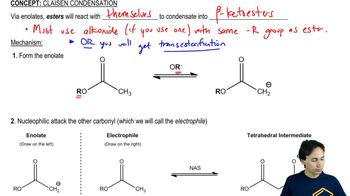
Claisen condensation is a reaction between two esters or an ester and a carbonyl compound in the presence of a strong base, typically sodium ethoxide. This reaction results in the formation of a β-keto ester or a β-diketone. Understanding this mechanism is crucial for predicting the products, as it involves nucleophilic attack and subsequent elimination of an alcohol.
Crossed Claisen condensation refers to a variation of the Claisen reaction where two different carbonyl compounds are used. This can lead to a mixture of products, making it essential to identify which compound acts as the nucleophile and which as the electrophile. The selectivity of the reaction is influenced by the reactivity of the carbonyl compounds involved.
Predicting the major products of a crossed Claisen condensation requires an understanding of the sterics and electronics of the reactants. Factors such as the stability of the resulting enolate and the ability of the carbonyl compounds to stabilize the negative charge play a significant role. Analyzing these aspects helps in determining the most likely product formed during the reaction.