Draw structures of the following derivatives. (f) the methyl hemiacetal of formaldehyde
Verified step by step guidance
1
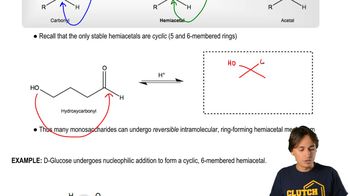
Step 1: Understand the concept of a hemiacetal. A hemiacetal is formed when an alcohol reacts with an aldehyde. It contains both an -OH group and an -OR group attached to the same carbon atom.
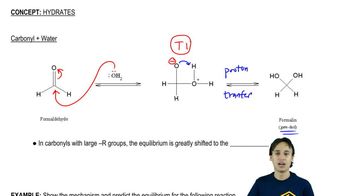
Step 2: Identify the starting material. Formaldehyde (CH₂O) is the simplest aldehyde, consisting of a carbonyl group (C=O) bonded to two hydrogen atoms.
Step 3: Recognize the alcohol involved in the reaction. The problem specifies 'methyl,' which refers to methanol (CH₃OH). Methanol will act as the alcohol in this reaction.
Step 4: Combine formaldehyde and methanol to form the methyl hemiacetal. The oxygen atom of the alcohol attacks the carbonyl carbon of formaldehyde, forming a new C-O bond. The carbonyl oxygen becomes protonated, resulting in an -OH group on the same carbon.
Step 5: Draw the structure of the methyl hemiacetal. The central carbon will have one hydrogen atom, one -OH group, one -OCH₃ group (from methanol), and one bond to the original oxygen from formaldehyde.
Verified video answer for a similar problem:
This video solution was recommended by our tutors as helpful for the problem above
Video duration:
3m
Play a video:
Was this helpful?
Key Concepts
Here are the essential concepts you must grasp in order to answer the question correctly.
Hemiacetals
Hemiacetals are organic compounds formed from the reaction of an alcohol with an aldehyde or ketone. They contain one hydroxyl group (-OH) and one alkoxy group (-O-R) attached to the same carbon atom, which is the carbonyl carbon of the aldehyde or ketone. Hemiacetals are typically unstable and can further react to form acetals when treated with an excess of alcohol.
Formaldehyde is the simplest aldehyde, with the chemical formula CH2O. It is a colorless gas at room temperature and is highly reactive due to the presence of the carbonyl group (C=O). In organic synthesis, formaldehyde is often used as a starting material for the preparation of various derivatives, including hemiacetals and acetals.
A methyl group is a functional group derived from methane (CH4) and is represented as -CH3. In the context of organic chemistry, the methyl group can influence the reactivity and properties of molecules. When forming a methyl hemiacetal from formaldehyde, the methyl group replaces one of the hydrogen atoms on the carbon atom of the hemiacetal structure, affecting its stability and reactivity.