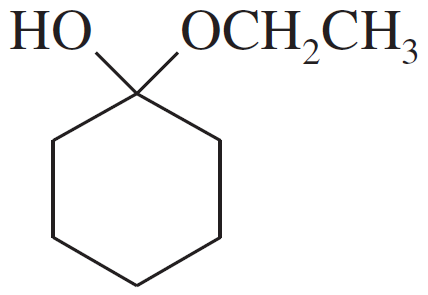
For each compound, 1. name the functional group. 2. show what compound(s) result from complete hydrolysis. (b)
Verified step by step guidance
1
Step 1: Identify the functional groups in the compound. The structure contains a hydroxyl group (-OH) and a methoxy group (-OCH₃) attached to a cyclopentane ring.
Step 2: Understand the concept of hydrolysis. Hydrolysis involves breaking chemical bonds using water, typically targeting ester, amide, or glycosidic bonds. In this case, the methoxy group (-OCH₃) is not hydrolyzable under normal conditions, as it is an ether group.
Step 3: Analyze the hydroxyl group (-OH). Hydrolysis does not affect hydroxyl groups directly, as they are already in their simplest form.
Step 4: Conclude that no new compounds are formed from complete hydrolysis of this molecule, as there are no hydrolyzable bonds present in the structure.
Step 5: Summarize the findings. The functional groups are hydroxyl (-OH) and methoxy (-OCH₃), and no hydrolysis products are formed because the molecule lacks hydrolyzable bonds.
Verified video answer for a similar problem:
This video solution was recommended by our tutors as helpful for the problem above
Video duration:
7m
Play a video:
Was this helpful?
Key Concepts
Here are the essential concepts you must grasp in order to answer the question correctly.
Functional Groups
Functional groups are specific groups of atoms within molecules that are responsible for the characteristic chemical reactions of those molecules. In organic chemistry, common functional groups include hydroxyl (-OH), methoxy (-OCH3), carboxyl (-COOH), and amine (-NH2). Identifying functional groups is crucial for understanding the reactivity and properties of organic compounds.
Hydrolysis is a chemical reaction involving the breaking of a bond in a molecule using water. In organic chemistry, hydrolysis often refers to the reaction of esters or amides with water to produce an alcohol and a carboxylic acid or amine, respectively. Complete hydrolysis of a compound can yield multiple products, depending on the functional groups present.
The structural representation of organic compounds, such as the one shown in the image, provides insight into the arrangement of atoms and functional groups within the molecule. Understanding these structures is essential for predicting the behavior of compounds during chemical reactions, including hydrolysis. The presence of hydroxyl and methoxy groups in the compound indicates potential sites for reactivity and transformation.