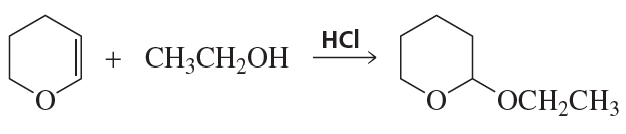
Propose a mechanism for each of the following reactions: b.
Verified step by step guidance
1
Step 1: Protonation of the epoxide ring - The reaction begins with the protonation of the oxygen atom in the epoxide ring by HCl. This step increases the electrophilicity of the epoxide, making it more susceptible to nucleophilic attack. The oxygen atom gains a positive charge, forming an oxonium ion.
Step 2: Nucleophilic attack by methanol (CH₃OH) - Methanol acts as a nucleophile and attacks one of the carbon atoms in the protonated epoxide ring. This attack occurs at the less sterically hindered carbon atom, leading to the opening of the epoxide ring.
Step 3: Formation of the intermediate - After the nucleophilic attack, a new bond is formed between the methanol oxygen and the carbon atom of the epoxide. The intermediate formed has a positively charged oxygen atom from the methanol group.
Step 4: Deprotonation of the intermediate - A base (possibly the chloride ion from HCl) removes the extra proton from the methanol group, neutralizing the positive charge and forming the final product.
Step 5: Final product - The reaction yields a methoxy-substituted cyclic ether, where the methanol group is attached to the carbon that was part of the epoxide ring.
Verified video answer for a similar problem:
This video solution was recommended by our tutors as helpful for the problem above
Video duration:
4m
Play a video:
Was this helpful?
Key Concepts
Here are the essential concepts you must grasp in order to answer the question correctly.
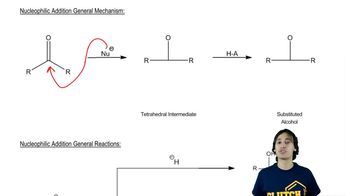
Nucleophilic Addition
Nucleophilic addition is a fundamental reaction in organic chemistry where a nucleophile attacks an electrophilic carbon atom, leading to the formation of a new bond. In this reaction, methanol (CH3OH) acts as the nucleophile, attacking the electrophilic carbon of the cyclic compound. This process is crucial for understanding how various functional groups can be introduced into organic molecules.
Protonation is the addition of a proton (H+) to a molecule, which can enhance its electrophilicity. In this reaction, HCl serves as a catalyst, protonating the oxygen atom of the cyclic compound, making it more susceptible to nucleophilic attack. This step is essential for facilitating the reaction and is a common strategy in acid-catalyzed organic reactions.
A reaction mechanism is a step-by-step description of the process by which reactants are converted into products. It outlines the sequence of bond-breaking and bond-forming events, providing insight into the intermediates and transition states involved. Understanding the mechanism of the nucleophilic addition in this reaction is vital for predicting the behavior of similar reactions and for designing synthetic pathways in organic chemistry.